Sunday column
Visiting Pamukkale: The Glorious Travertine Pools of Turkey
During our honeymoon in Turkey, my husband and I visited two unforgettable places: the travertine terraces of Pamukkale and Cleopatra’s Pool within the Hierapolis archaeological complex. Our tour only allowed about two hours for the entire visit, which felt far too short. Still, whether you have a brief stop or a full day, the site is absolutely worth seeing.
Liam Carter
Desk editor
Editor’s note
The full column continues in quiet type below.
Section
Sunday Broadsheet
During our honeymoon in Turkey, my husband and I visited two unforgettable places: the travertine terraces of Pamukkale and Cleopatra’s Pool within the Hierapolis archaeological complex. Our tour only allowed about two hours for the entire visit, which felt far too short. Still, whether you have a brief stop or a full day, the site is absolutely worth seeing.
We arrived in Pamukkale in the afternoon, which turned out to be a good choice since it helped us avoid the strongest midday heat and the largest crowds. Our guide covered the entrance fee, which is usually around 35 Turkish Lira (children under 18 can enter for free). We walked past rows of souvenir stands and snack vendors, eager to finally reach the natural wonder we had come to see.
The walk from the parking area to the travertines and even further on to Cleopatra’s Pool is fairly long, but it’s an enjoyable route. Along the way, you pass scattered ruins from the ancient Greco-Roman city of Hierapolis, also known as the “Sacred City.” The path itself is made of uneven natural stones that create a faint, almost musical clicking sound underfoot as you walk.
Hierapolis was originally founded by the Attalid rulers of Pergamon in the late second century BC and later came under Roman control in 133 BC. It became well known for its thermal waters, which attracted people seeking relief from ailments such as skin conditions and rheumatism. My husband, who loves history and ancient ruins, was a bit disappointed that we didn’t have enough time to explore the full archaeological remains or visit the museum nearby, so anyone interested in Hierapolis should definitely plan a longer stay.
The Travertines
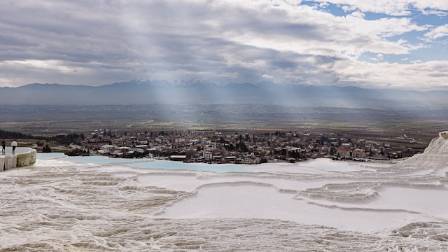
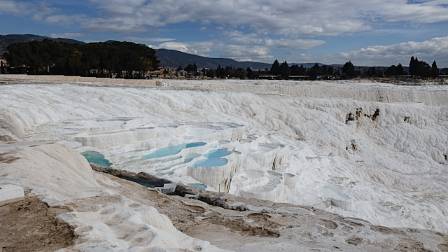
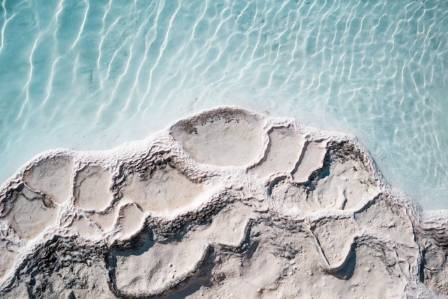
The main highlight, of course, is the famous travertine terraces. We visited Cleopatra’s Pool first, then continued on to explore the terraces. Pamukkale translates to “Cotton Castle,” a fitting name for its bright white landscape formed by mineral-rich hot springs. Over time, calcium carbonate deposits created dazzling white basins, frozen cascades, and terrace-like formations. These natural pools are formed by sedimentary rock left behind by flowing thermal water, giving the impression of stepped pools filled with pale turquoise water.
The travertines felt like they could be divided into three main zones. Near the southern entrance, there is an area where visitors are allowed to walk into the shallow pools and take photos. Beyond that section, there are additional terraces, though many of them were completely dry during our visit. Further north, a boardwalk leads to more pristine-looking pools. When we reached this area later in the afternoon, the sunlight was softer, and the remaining water shimmered beautifully. It was surprisingly quiet, and the setting felt almost inviting, although clear signs strictly prohibited entering the water.
Before our trip, I had read mixed reviews and was worried there might be little or no water at all. Fortunately, there was still water present in several areas, although not as abundant or dramatic as many of the idealized photos online. Our guide explained that nearby hotels divert a significant amount of the spring water for their own use, which affects how full the terraces appear. I also read other explanations suggesting different reasons, but this was the one we were told locally.
From certain points near the public pools, you can see the modern resort town in the distance, which creates an interesting contrast with the natural white formations and the blue lake below.
Cleopatra’s Pool
Beyond the travertines and a small museum area lies Cleopatra’s Pool. After visiting ancient sites such as the Acropolis in Greece and Ephesus in Turkey earlier on our honeymoon, what made this pool especially unique was the opportunity to actually swim among ancient ruins. Floating in warm, mineral-rich water while surrounded by submerged stone columns was both unusual and memorable. The broken pillars are believed to be remnants of a collapsed Temple of Apollo, and legend says the pool was once a gift from Mark Antony to Cleopatra.
The only photo we managed to capture came thanks to a kind traveler from our tour group.
Around the pool, there are gift shops, restaurants with higher prices, changing rooms, lockers, and bathrooms. One downside is that swimming requires a separate fee of about 50 TL. Visitors also need to bring their own towel, and phones or cameras are not allowed in the water. Instead, professional photographers on-site offer paid photo services.
Online reviews often complain about crowds and the photography restrictions. While there were certainly visitors during our trip, it didn’t feel as overwhelming as some comments had suggested. It may depend heavily on the time of year or day. Even though it can feel a bit commercialized, we still found the experience enjoyable overall.
My Biggest Regret
This part of the trip also came with a personal lesson. I was very focused on capturing beautiful photos for social media, and that mindset led me to make decisions I later regretted. Instead of fully enjoying the moment, I became overly concerned with how the pictures would turn out.
At one point, I decided I wanted professional photos in the travertines. I was hesitant to bring my phone into the water, and I also didn’t have a way to take photos myself since my husband didn’t want to join me in the pools. Eventually, I agreed to use one of the on-site photography services, even though I felt unsure about it.
They showed examples of women posing in the pools, sometimes with parrots, and I assumed I could choose the style I wanted. However, once I went in, the photographer placed a parrot with me and only took those kinds of shots. Afterward, I was shown the pricing, which was far higher than expected. With the help of a fellow tour member who spoke Turkish, I tried to explain that I wanted different types of photos and that the price was too high.
What followed was a confusing back-and-forth. I was taken for another round of posed photos, and in the end, the cost kept increasing as more images were added. Eventually, after much negotiation and frustration on both sides, I managed to reduce the price significantly, but it was still far more than I had intended to spend for a set of unedited images.
By the time everything was resolved, I had fallen behind my tour group and lost valuable time at the travertines themselves. More importantly, I realized I had spent much of the visit worrying about photos instead of simply enjoying the experience of being there.
Pamukkale at Night
We stayed overnight at the Colossae Thermal Hotel. While the rooms were somewhat outdated, the hotel itself offered a large dining area with a wide variety of food, giving it a feel somewhat similar to a cruise ship buffet. That evening, we watched a complimentary belly dance performance and relaxed with a few drinks. Depending on the season, the price was around $118 per night, which felt reasonable for a four-star stay. The hotel also had thermal pools and a mud bath, though we didn’t have time to use them.
The following morning, before leaving the area, we visited the lake below the cliffs. From there, we were able to see Pamukkale from a completely different angle, looking up at the white terraces above. People were relaxing by the water, and ducks gathered near the shore, adding a peaceful atmosphere to the scene.
Final Thoughts
There are entrances, transport options, and maps available online for anyone planning a visit. The travertines are generally open from mid-April to early October with longer hours, and shorter hours during the winter season. The surfaces can be extremely slippery, both at the terraces and at Cleopatra’s Pool, so visitors should be careful, especially with cameras or phones.
Sunset is often said to be one of the most beautiful times to experience Pamukkale, and even the brief glimpse we caught was stunning.
Despite a few regrets and rushed moments, I’m very glad we had the chance to see Pamukkale in person. It’s a place I would love to return to someday, with more time to explore Hierapolis, relax in the water, and simply take in the landscape without rushing.
More from the edition
Column · en
Top 10 Most Dependable Vans
Dependability is a crucial factor when it comes to commercial vehicles. Ensuring that your vehicle maintains top-notch performance is key to the ongoing success of your business. Below, we’ve compiled a list of the most reliable vans currently available in the UK, which are part of the reason Vanwise is known for offering great value in vans for sale. Take a look at the list and reach out to our sales team for more information.
Column · en
The 10 Most Famous Pieces of Street Art in the World
Street art emerged in 1960s Philadelphia, USA, fueled by the creative drive of pioneering artists like Cornbread and Cool Earl. Long dismissed as a lesser art form, this genre encompasses everything from wall tags and public transit murals to building-scale pieces. Though often unauthorized and transient—easy to paint over or remove—street art has nonetheless captured the imagination of countless creators and admirers. At its core, it seeks to make art accessible and visible to the masses, serving as a vehicle for profound messages that spark reflection. Today, some street artworks command million-dollar price tags and stand as celebrated masterpieces. Artsper highlights 10 of the most iconic street art pieces across the globe.
Column · en
Gooderham Tower, Canada’s Most Iconic Flatiron
Often called Toronto’s Flatiron Building, the Gooderham Building stands as one of the city’s most cherished landmarks. Located at the junction of Wellington Street and Front Street, it displays remarkable architectural design while also reflecting the legacy of a leading Toronto family that played a major role in the region’s industrial development.
Column · en
Top 5 Best Off-Road Motorcycles
Riding off-road isn’t just about speed—it’s about freedom, adrenaline, and the thrill of exploring untamed trails. From steep rocky climbs to sandy paths, the right motorcycle transforms the experience. Picking the perfect bike depends on your style, skills, and terrain. Here’s a look at five standout models and the essentials to consider before your next adventure.
Column · en
Building Dimension and Realism: Vital Techniques for Watercolor Landscape Painters
Capturing the natural world through watercolor is a pursuit defined by an appreciation for atmospheric clouds, the nuances of natural light, and the rhythmic transition of the seasons. The outdoors offers infinite inspiration, but translating the vastness of a three-dimensional environment onto a flat sheet of paper requires a strategic approach. To emulate the beauty of the world effectively, artists must master the balance between technical skill and thoughtful preparation.
Column · en
Hydrangea Growing Guide
Hydrangeas, commonly known as hortensias, are popular flowering shrubs admired for their abundant blooms and decorative foliage. With proper planting, pruning, and maintenance, these plants can provide impressive displays year after year.