
Sunday column
Pronghorn: Racers on the Great Plains
Badlands National Park provides a home for the pronghorn, which is sometimes called the pronghorn antelope. Despite its nickname, the pronghorn is not actually a true antelope. However, it shares several characteristics with genuine antelopes found in Africa and Asia. These similarities are the result of convergent evolution, in which unrelated animals independently develop comparable traits because they face similar environmental conditions. The pronghorn is the only surviving species in the family Antilocapridae, and its closest living relatives are actually giraffes.
Livia Snow
Desk editor
Editor’s note
The full column continues in quiet type below.
Section
Sunday Broadsheet
Badlands National Park provides a home for the pronghorn, which is sometimes called the pronghorn antelope. Despite its nickname, the pronghorn is not actually a true antelope. However, it shares several characteristics with genuine antelopes found in Africa and Asia. These similarities are the result of convergent evolution, in which unrelated animals independently develop comparable traits because they face similar environmental conditions. The pronghorn is the only surviving species in the family Antilocapridae, and its closest living relatives are actually giraffes.
A Day in the Life
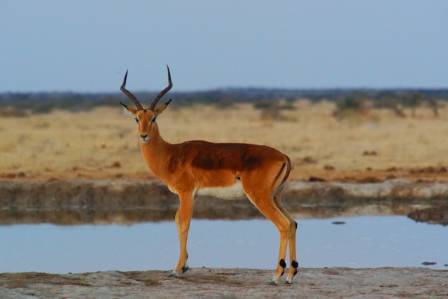
At a distance, pronghorns can sometimes be mistaken for deer, but their differences become obvious when viewed more closely. Pronghorns are generally smaller than deer and stand about three feet tall at the shoulder. They are recognizable by the bright white patches of fur on their rump, sides, underside and throat.
Male pronghorns develop distinctive branching horns that can reach approximately one foot in length, which is the feature that gives the animal its name. Females may also have horns, but theirs are much shorter and generally straight. Their horns differ from deer antlers because they grow around a permanent bony core covered by skin rather than being shed entirely. However, like the horns of a bison, the outer keratin sheath is shed and subsequently replaced.
Pronghorns inhabit open prairie landscapes throughout western North America, ranging from parts of Canada to Mexico. They are herbivores that feed on shrubs, grasses and various flowering plants growing across the plains. The wide, unobstructed prairie also gives them an important advantage when predators approach: their extraordinary running ability.
Need for Speed
Speed is perhaps the most remarkable characteristic of the pronghorn. Their long legs, lightweight bodies, large windpipes and cushioned hooves allow them to maintain speeds of around 55 miles per hour for roughly half a mile. They can also travel at speeds close to 45 miles per hour over considerably longer distances.
No modern predator living within the pronghorn's range is capable of matching this remarkable pace, which has long intrigued scientists. Researchers believe this extraordinary speed may have evolved as a defense against the American cheetah, a remarkably fast ambush predator that once inhabited North America. The American cheetah disappeared from the continent approximately 12,000 years ago, but the pronghorn's impressive speed remains.
Pronghorns in the Badlands
Within Badlands National Park, pronghorns are most commonly encountered in large, uninterrupted grassland areas. In the North Unit, visitors may spot them in the grasslands north of Badlands Loop Road, also known as Highway 240, as well as in the Buffalo Gap National Grassland bordering the park.
Pronghorn sightings have also been recorded both above and below Sheep Mountain Table, near the boundary between the North Unit and South Unit. Their preference for open grassland makes these areas particularly suitable places to look for these remarkably fast animals.
More from the edition
Column · en
Best Classic British Cars in History
From Sean Connery’s unforgettable drives in the legendary Aston Martin DB5 as James Bond, to the timeless Mini and the elegant curves of the Jaguar E-Type, British automotive history is filled with iconic machines. These remarkable vehicles easily earn a place among the greatest classic cars ever produced in the UK. Let’s explore the top 10—see which legends made the cut and which ones didn’t. The choices are tough…
Column · en
Tiramisu Unveiled: Fascinating Insights into Italy’s Iconic Coffee Dessert
Tiramisu is a globally celebrated Italian sweet known for its rich coffee flavor and luxurious layers. While it is a staple in Italian cuisine, the dessert is a subject of much debate regarding its true heritage. Traditionally, the dish is constructed by soaking porous sponge cakes, such as ladyfingers, in potent espresso. These are then layered with a velvety mixture of mascarpone cheese and zabaglione—a whipped custard typically flavored with Marsala wine. A final dusting of bitter cocoa powder or chocolate shavings provides the perfect contrast to the creamy interior.
Column · en
Ultimate Guide to the Stunning Sky High Adventures in Lujiazui Shanghai
Welcome to the dazzling core of the financial hub of Shanghai, where the spectacular cityscape serves as an incredible display of contemporary design and technological advancement. When you arrive in this energetic neighborhood, you will encounter a magnificent collection of soaring structures that define the city line while showcasing incredible engineering ambition. From the grand twisting mega towers to the distinctive spherical structures, this destination remains an essential stop for anyone wanting to see the absolute finest sights in the region.
Column · en
How to Choose the Ideal Suit for Your Body Type
A poorly fitted or ill-suited suit can instantly undermine your sense of style. All too often, we see men wearing jackets that are too baggy, too long, or hopelessly out of date—mistakes that can easily be avoided.
Column · en
6 of the World’s Most Impressive Piers
Across coastlines worldwide, piers stand as a bridge between land and sea. Some are beloved for their seaside entertainment, others are marvels of history, while a few are celebrated simply for their sheer size. Built from timber, concrete, or steel, these structures have become icons of both engineering and culture. Here are six of the most extraordinary piers on the planet.
Column · en
5 Spanish Castles You Can Stay In
Across Spain, the countryside is filled with ancient castles and palaces that have watched over towns and villages for hundreds of years. Although kings, queens, and nobles no longer inhabit these historic buildings, many of them have been carefully restored and transformed into unique hotels. Staying in one of Spain’s Paradores offers the rare chance to step directly into history and experience life in a medieval or Renaissance setting. Here are five remarkable castle hotels where guests can enjoy a truly royal stay.