
Sunday column
Things You Didn’t Know About: Bee-eaters
Wildlife SOS’s “Things You Didn’t Know About” series highlights unusual and fascinating information about different wild species. Each feature focuses on one animal and explores the special traits that make it important within its ecosystem. Bee-eaters are a particularly fascinating group of birds, known for their vivid colors and extraordinary ability to catch flying insects while in the air.
Orin Maddox
Desk editor
Editor’s note
The full column continues in quiet type below.
Section
Sunday Broadsheet
Wildlife SOS’s “Things You Didn’t Know About” series highlights unusual and fascinating information about different wild species. Each feature focuses on one animal and explores the special traits that make it important within its ecosystem. Bee-eaters are a particularly fascinating group of birds, known for their vivid colors and extraordinary ability to catch flying insects while in the air.
Imagine walking along a street when a sudden flash of green darts past you. You may notice a long, unusual extension at the end of its tail, but before you can get a closer look, the bird has disappeared. This is the fascinating world of bee-eaters. These birds are remarkably agile flyers, and when one is spotted, there is a good chance that more members of its flock are close by.
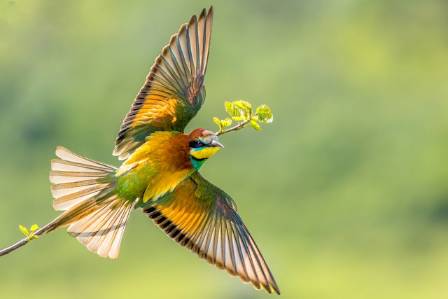
Several bee-eater species have elongated central tail feathers that extend beyond the rest of the tail, creating a distinctive pin-like appearance. This unusual feature can make them easier to identify.
As their common name suggests, bee-eaters feed on bees as well as numerous other flying insects. Their most impressive hunting behavior is the ability to seize prey while both predator and insect are airborne. The IUCN recognizes as many as 31 bee-eater species distributed across four continents: Asia, Australia, Africa, and Europe. Although species and subspecies from different regions can display a wide variety of colors, they generally share several physical characteristics, including a medium-sized slender body and a curved bill adapted for capturing prey.
India is home to six bee-eater subspecies.
The most widespread species is the Asian green bee-eater (Merops orientalis), which is also commonly called the green bee-eater. It occupies a surprisingly broad range of habitats, including wetlands, grasslands, and dense forests. These adaptable birds can even appear in urban parks and green spaces close to people's homes.
Theory of Mind
The phrase “theory of mind” may sound complicated, but the basic idea is relatively simple. It describes the ability to consider what another individual may be thinking or intending.
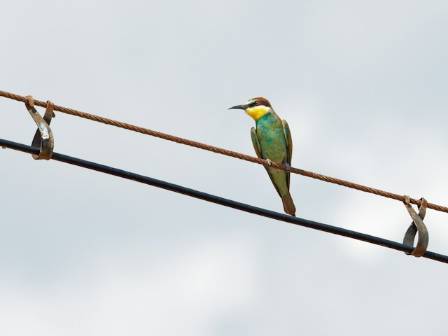
Consider a scene near sunset, when most birds have already begun returning to their nighttime shelters. A bee-eater may remain perched on a wire while a person watches it from below. The bird recognizes that it is being observed and may deliberately remain where it is rather than flying away. Leaving the perch could reveal the location of its nest and expose its eggs or chicks to a possible threat.
This behavior demonstrates an unusual level of awareness of another individual's attention. The ability to understand or respond to what an intruder may know is uncommon in the animal world and has traditionally been associated with only a small number of highly intelligent animals, including great apes such as chimpanzees, bonobos, and orangutans.
Bee-eaters are also remarkably productive hunters and can capture as many as 250 bees or other insects in a single day.
Removing a Bee’s Stinger
Bee-eaters are insect-eating birds, and bees make up an important part of their diet. Bees, however, possess a potentially dangerous weapon in the form of a venomous sting. Bee-eaters have developed an effective technique for safely consuming this risky prey.
After catching a bee in midair with its curved bill, the bird carries the insect to a branch. It then repeatedly strikes the bee against the branch to subdue it. Once the insect has been weakened, the bee-eater rubs the bee's rear end and venom sac against the branch to remove the dangerous parts.
The bird closes its eyes while performing this action, helping protect them from venom that may be sprayed during the process. After the bee has been effectively disarmed, the bird tosses its prey into the air and catches it before swallowing it whole.
Monogamous Partners
Another notable characteristic of bee-eaters is their tendency to form monogamous pair bonds. After selecting a mate, a pair may remain together for life.
Before the female lays her eggs, the male and female cooperate in preparing their nesting site. They excavate long tunnels in the ground, with nesting passages reaching approximately one to two meters in length. The chamber at the end of the tunnel provides a protected place where the eggs can be laid and incubated.
Because the pair works together as long-term partners, both parents participate in raising their offspring. Incubating the eggs and providing food for the chicks are shared responsibilities between the male and female.
A female bee-eater may lay between two and seven eggs in a nesting tunnel dug into sandy ground.
Aerial Hunters
Watching a bee-eater fly can be an extraordinary experience. In India, the bird's body has sometimes been compared to a bow, while its elongated bill resembles an arrow. When the wings are extended, they form a distinctive triangular shape, and the bird's movements through the air resemble an impressive aerial performance.
Bee-eaters are not only fast but also possess excellent vision. They can detect potential prey flying as far as approximately 60 meters away.
When an Asian green bee-eater takes to the air, the beautiful orange coloration beneath its wings becomes particularly noticeable.
Dust Bathing
Many birds have oil glands near the base of their tails that produce an oily or wax-like substance. During preening, birds spread this material across their feathers with their bills. The oil helps make the feathers water-resistant and supports efficient movement through the air.
However, an excessive buildup of oil can become undesirable. When this happens, bee-eaters may perform a behavior known as dust bathing. They rapidly move and wriggle across the ground, throwing dust onto their bodies. The excess oil sticks to the dust particles, which can then be removed as the bird shakes and flaps its feathers.
Dust bathing also provides another benefit because it can help remove parasites that become lodged among the bird's brightly colored feathers.
Many bee-eater species have a distinctive black stripe across the eye, beginning near the bill and extending toward the area behind the eye.
Communication in the Community
Although bee-eaters may form monogamous pairs, they are also highly social birds that enjoy living among other members of their species. It is common for several individuals to gather closely together on a single narrow perch.
Finding a bee-eater completely by itself can therefore be unusual. Their social groups may include multiple generations, creating communities that resemble extended families. Their constant calls and interactions keep these groups active and lively.
Asian green bee-eaters have particularly strong social connections. When a pair begins digging a nesting tunnel, other members of the flock may assist with the excavation.
Monomorphic Birds
In many bird species, males and females are relatively easy to distinguish because males often have much brighter or more elaborate physical features. Bee-eaters are different because the two sexes generally look remarkably similar.
There are only subtle differences between males and females. For example, males may have slightly longer tails, although this difference can be difficult to notice from a distance. In some bee-eater species, males may also display somewhat brighter coloration, but these variations are not always obvious when observing the birds in the field.
Their Role in the Ecosystem
Every species contributes in some way to the balance of its ecosystem. Bee-eaters help regulate populations of flying insects by consuming large numbers of bees, wasps, and other insects.
As birds, they also contribute to ecosystem processes such as seed dispersal, helping support the continued health of the habitats in which they live.
Unfortunately, widespread habitat degradation can create serious problems for bee-eaters. The destruction of suitable habitat not only removes places where these birds can live and nest but can also reduce the insect populations they rely on for food.
Now that these fascinating characteristics of bee-eaters are better understood, the next time you walk through a green area in your city, it may be worth watching carefully for a sudden flash of color overhead. These agile and social birds are an important part of the natural world and the ecosystems they inhabit.
More from the edition
Column · en
Beyond Pad Thai: 10 Hidden Gems of Thai Gastronomy
Thai cuisine is celebrated worldwide, yet many travelers rarely venture beyond the standard tourist favorites. For those with an adventurous palate, Thailand offers a complex landscape of flavors that balance sweetness, acidity, saltiness, and intense heat. To truly experience the depth of this culinary tradition, one must look toward regional specialties, street-side delicacies, and traditional home-style cooking.
Column · en
Key Insights into the Nature of Black Holes
A black hole is fundamentally a region in space where the gravitational pull is so intense that nothing can escape its grasp. This extreme gravity is the result of matter being squeezed into a tiny space. While these cosmic entities may seem mysterious, understanding their characteristics helps clarify how the universe operates at its most extreme limits.
Column · en
From Fiction to Function: 8 Technologies Shaping Our Future
The line between science fiction and scientific achievement is rapidly blurring. Innovations once confined to the pages of novels and movie screens are now emerging from laboratories and workshops, fundamentally changing how we live, work, and interact with the world. Here are eight technologies leading this transformation from speculative fantasy to tangible reality.
Column · en
Seven Things to know about Moose
North American moose are generally divided into four subspecies, each occupying a different geographic region.
Column · en
Top 7 Breathtaking Ocean Views Around the World
Few things stir the soul like standing before the endless horizon where sea, sky, and land collide. From dramatic cliffs and hidden bays to iconic coastlines, the planet offers countless vantage points where the ocean feels larger than life. Whether you’re chasing sunsets, photographing waves, or simply soaking in nature’s grandeur, these seven ocean panoramas are among the most unforgettable.
Column · en
Secrets of the Incredible Green Sea Turtle and the Urgent Fight to Save It
The green sea turtle stands out as the absolute largest species among all hard-shelled marine turtles. Unlike their omnivorous or carnivorous relatives, adult green sea turtles are highly unique because they live primarily as herbivores, consuming vast quantities of seagrasses and marine algae. On rare occasions, they might supplement this plant-based diet with sea sponges, various small invertebrates, or discarded fish scraps when they happen to encounter them. Interestingly, the common name of this creature does not stem from the coloration of its external shell, but rather from the distinctly green tint of its internal fat layer. Early observers believed this unusual internal coloration was entirely due to their specialized vegetarian diet, though modern researchers now know that other marine turtle species can also possess greenish subdermal fat.