Sunday column
Famous Flower Paintings: Celebrating Nature's Beauty
Flowers have inspired artists for centuries, appearing in countless masterpieces across different artistic movements and eras. Their brilliant colors, graceful forms, and symbolic meanings have made them a favorite subject for painters seeking to express beauty, emotion, and the passage of time. From Impressionist gardens to bold modern interpretations, floral artworks continue to captivate audiences around the world.
Frederick Lockhart
Desk editor
Editor’s note
The full column continues in quiet type below.
Section
Sunday Broadsheet
Flowers have inspired artists for centuries, appearing in countless masterpieces across different artistic movements and eras. Their brilliant colors, graceful forms, and symbolic meanings have made them a favorite subject for painters seeking to express beauty, emotion, and the passage of time. From Impressionist gardens to bold modern interpretations, floral artworks continue to captivate audiences around the world.
In this collection, we explore ten celebrated flower paintings that demonstrate how artists have transformed blossoms into timeless works of art.
1. Sunflowers (1888) – Vincent van Gogh
Few floral paintings are as recognizable as Vincent van Gogh’s Sunflowers series. These striking compositions feature bright yellow sunflowers arranged in simple vases, painted with energetic brushstrokes and vivid color.
Beyond their visual appeal, the flowers symbolize growth, renewal, and the natural cycle of life. The series also reflects Van Gogh’s search for beauty, hope, and emotional expression through art.
2. Water Lilies (1914–1926) – Claude Monet
Claude Monet devoted many years to painting the water garden at his home, resulting in the famous Water Lilies series. These paintings immerse viewers in a peaceful world of floating blooms, reflective water, and shifting light.
Using soft colors and loose brushwork, Monet created dreamlike scenes that capture both the beauty of nature and the fleeting effects of changing atmosphere.
3. Irises (1889) – Vincent van Gogh
Another masterpiece by Van Gogh, Irises showcases his remarkable ability to combine intense color with expressive texture. The painting presents a vibrant arrangement of blooming irises brought to life through swirling brushstrokes and dynamic contrasts.
The work highlights Van Gogh’s fascination with nature and his unique approach to capturing its energy and movement.
4. The Birth of Venus (1484–1486) – Sandro Botticelli
Although not strictly a flower painting, Botticelli’s The Birth of Venus features an abundance of blossoms surrounding the goddess of love. Venus emerges from the sea upon a shell, while flowers drift through the air around her.
The painting uses floral imagery to symbolize beauty, romance, fertility, and divine grace, making flowers an essential element of its visual storytelling.
5. The Water Lily Pond (1899) – Claude Monet
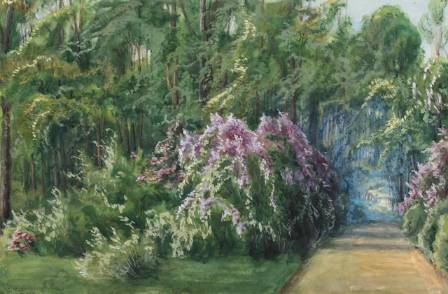
In this beloved painting, Monet depicts the famous Japanese bridge crossing his garden pond. Water lilies float gently on the surface, surrounded by lush vegetation and reflected light.
The work demonstrates Monet’s dedication to observing nature and his desire to portray its constantly changing moods through color and light.
6. Red Poppy (1927) – Georgia O’Keeffe
Georgia O’Keeffe became renowned for her enlarged flower paintings, and Red Poppy is one of her most striking examples. By focusing closely on a single bloom, she reveals intricate details that often go unnoticed.
The bold composition encourages viewers to appreciate the complexity and beauty hidden within everyday natural forms.
7. The Rose (1925) – Salvador Dalí
Salvador Dalí approached floral imagery from a Surrealist perspective. In The Rose, familiar forms are transformed into dreamlike and unexpected shapes.
Rather than simply depicting a flower realistically, Dalí uses distortion and symbolism to explore imagination, mystery, and the subconscious mind.
8. Vase with Fifteen Sunflowers (1888) – Vincent van Gogh
Another celebrated work from Van Gogh’s sunflower series, Vase with Fifteen Sunflowers radiates warmth and vitality. Thick layers of paint and rich golden tones create a sense of energy that seems to leap from the canvas.
The painting remains one of the artist’s most beloved achievements and a powerful example of his expressive style.
9. Black Iris (1926) – Georgia O’Keeffe
In Black Iris, O’Keeffe magnifies a single flower until it becomes almost abstract. The close-up view transforms the familiar iris into a flowing arrangement of shapes, colors, and shadows.
This approach invites viewers to see the flower from a completely new perspective and appreciate its hidden elegance.
10. Amaryllis (1934) – Georgia O’Keeffe
O’Keeffe’s Amaryllis demonstrates her talent for creating impactful compositions through simplicity. The painting focuses closely on the flower, emphasizing its graceful curves and subtle color variations.
By eliminating unnecessary distractions, she allows the beauty of the bloom itself to become the central focus of the artwork.
Conclusion
These ten remarkable flower paintings demonstrate the enduring relationship between art and nature. From the radiant sunflowers of Vincent van Gogh to the tranquil water lilies of Claude Monet and the bold floral studies of Georgia O’Keeffe, each artist offers a distinct interpretation of blossoms and their significance.
Together, these works remind us that flowers are more than decorative subjects. They symbolize beauty, change, emotion, and the fleeting moments of life. Their presence in art continues to inspire viewers across generations, proving that the fascination with flowers is as timeless as art itself.
More from the edition
Column · en
6 Entertaining Qualities of Cats
Many individuals mistakenly consider cats to be dull and lacking in personality. To these uninformed skeptics, I emphatically declare, "pshaw!" Cats are not only amusing but often downright hysterical. Those who remain doubtful about the comical nature of cats likely haven't spent a significant amount of time in their feline company.
Column · en
Embark on a Journey of Discovery Through World-Famous Paintings with Hidden Meanings
Art is not merely a creative endeavor; it is a profound medium for the expression of human emotions and sentiments. The term "painting" carries different connotations for different individuals. To some, it represents a vibrant adventure, while for others, it serves as a therapeutic means of alleviating stress and anxiety. The undeniable creative power of art and painting is a force that transcends boundaries. Artists around the globe utilize painting as a channel to convey their innermost thoughts and feelings in a visually captivating and aesthetically pleasing manner. In this article, we delve into renowned paintings that conceal hidden meanings.
Column · en
Mastering Sunset Art: A Comprehensive Alcohol Marker Tutorial
Creating a breathtaking sunset illustration may appear complex, but it is remarkably approachable when broken down into logical phases. This guide explores how to utilize alcohol markers and a touch of colored pencil to render a vibrant evening landscape. By layering specific hues of orange, pink, and violet, you can achieve a professional-grade transition from the glowing sun to the deepening sky.
Column · en
Tusks and Horns: The World of Elephants and Rhinos
Welcome to the third chapter of Legacy Watch, an educational series dedicated to celebrating Africa’s remarkable wildlife. These stories about threatened mammals were created by a conservation pioneer and were originally shared with children during storytelling sessions and around campfires. Today, they are available online to help families learn more about wildlife protection and inspire the next generation to care for animals. In this edition, we explore two extraordinary endangered mammals: the powerful African elephant and the impressive rhinoceros.
Column · en
Dimming Stars: The Plight of 10 Renowned Endangered Species
In the grand tapestry of Earth's biodiversity, some species shine brighter than the rest. These remarkable creatures, often referred to as "charismatic megafauna," possess a unique allure that has been harnessed by conservationists to garner support for their protection. Beyond their charismatic appeal, these endangered animals play a pivotal role in maintaining the balance of their complex ecosystems. Let's delve into the stories of these illustrious but endangered species, shedding light on their challenges and the urgent need for conservation.
Column · en
8 Cool Wild Cats You Probably Don’t Know
Big cats are among the most charismatic and recognizable wildlife species on Earth. Lions and tigers star as mascots, cartoon characters, and nature documentary headliners—most of us know the basics of their life cycles and conservation status.