Sunday column
Mastering Sunset Art: A Comprehensive Alcohol Marker Tutorial
Creating a breathtaking sunset illustration may appear complex, but it is remarkably approachable when broken down into logical phases. This guide explores how to utilize alcohol markers and a touch of colored pencil to render a vibrant evening landscape. By layering specific hues of orange, pink, and violet, you can achieve a professional-grade transition from the glowing sun to the deepening sky.
Nathaniel Sinclair
Desk editor
Editor’s note
The full column continues in quiet type below.
Section
Sunday Broadsheet
Creating a breathtaking sunset illustration may appear complex, but it is remarkably approachable when broken down into logical phases. This guide explores how to utilize alcohol markers and a touch of colored pencil to render a vibrant evening landscape. By layering specific hues of orange, pink, and violet, you can achieve a professional-grade transition from the glowing sun to the deepening sky.
Essential Art Supplies
To replicate this specific color palette and texture, a set of high-quality alcohol markers is necessary. The primary colors utilized include a pale primrose yellow, a warm moccasin orange, fluorescent red, strawberry pink, and two variations of deep violet and lavender. A classic black marker is also required for the silhouette of the foreground.
Beyond markers, a high-quality white colored pencil is vital for adding final highlights and fine details. Because alcohol markers require a specific surface to blend smoothly without bleeding, using dedicated marker paper or a smooth illustration board is highly recommended for the best results.
Establishing the Composition
The first step in any landscape is defining the layout. Begin by drawing a horizontal line approximately one-third of the way up from the bottom of your page. This horizon line represents the boundary between the water and the land, and it does not need to be perfectly straight, as natural coastlines are often irregular.
Once the horizon is set, add depth by sketching a series of hills just above the line. To create a sense of perspective, draw two distinct rows; the hills in the front should be positioned lower than the peaks behind them. Finally, sketch the sun as a semi-circle positioned in the center of the horizon, and add a few light outlines for cloud formations in the upper portion of the page.
Coloring the Terrain and Water
The coloring process begins with the landscape to establish the contrast against the bright sky. Start with the hills closest to the sun using a vibrant fluorescent red to mimic the intense glow of the sunset. For the remaining sections of the distant hills, apply a dark violet, blending it into the red areas to create a seamless transition of light.
For the foreground hills and the body of water, use a dark lavender shade. To finalize the terrestrial elements, use a black marker to define the shoreline. Using a slightly shaky or "wiggly" stroke here will give the shore a more realistic, rocky appearance.
Rendering the Sky and Clouds
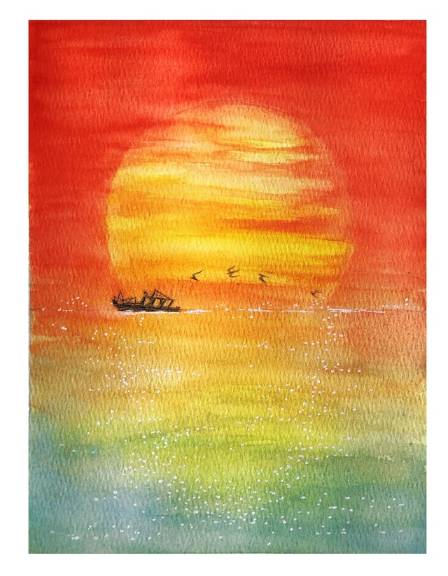
The sky is where the gradient truly comes to life. Begin by filling the sun with a pale yellow. Immediately surround the sun and its adjacent clouds with a light moccasin orange. Utilizing the brush nib of your marker during this stage will allow you to create streaky, atmospheric effects that resemble moving clouds.
Progression is key for the upper sky. Transition from the orange into a fluorescent red, then into a strawberry pink. To achieve a smooth gradient, always use the lighter of the two overlapping colors to "ink over" the boundary where they meet, which softens the transition. As you reach the top of the page, apply dark violet to represent the approaching night, blending it back down into the pink sections. Add smaller, darker cloud shapes within these layers to provide texture and depth.
Adding Highlights and Final Details
The final aesthetic touch involves using a white colored pencil to simulate reflected light. Apply light pressure to draw a few horizontal "wave lines" across the water’s surface. You should also add bright accents to the edges of the orange clouds above the sun to suggest they are being illuminated from below.
To give these highlights more impact, return to your lavender marker and add dark streaks directly beneath the white lines in the water. This contrast between the bright white and the deep purple creates the illusion of moving waves and ripples. This combination of layering, blending, and highlighting results in a vivid, professional landscape that captures the essence of a summer evening.

More from the edition
Column · en
Sculpted by the Sea: The Dynamic Geology of Rocky Coastlines
The relentless pounding of surf and breaking waves has shaped rocky coasts into some of the most dramatic landscapes on Earth. Characterized by high-energy erosion, these coasts are typically found along active tectonic margins with narrow continental shelves. Composed of sedimentary, igneous, or metamorphic rock, they bear witness to complex geological processes, including faulting, folding, and volcanic activity. The specific profile of a rocky coast—whether steep cliffs or gentle slopes—is dictated by the interplay of bedrock resistance, climate, and wave energy. For instance, the resistant lava flows of Kalaupapa National Historical Park (Hawaii) create towering sea cliffs, while the more erodible limestones of Dry Tortugas National Park (Florida) form gentler slopes. Glacial activity further sculpts these regions, carving deep fjords and depositing talus slopes, while carbonate coasts can lithify into eolianite dunes that later erode into steep bluffs.
Column · en
Eight Classic Sunglasses Styles for Timeless Elegance
The world of sunglasses is awash with fleeting trends, but certain styles effortlessly transcend seasons, years, and even decades. These timeless sunglasses styles are universally flattering and serve as enduring fashion statements.
Column · en
How to Build a Snow Cave
A quinzee is a large mound of snow that is allowed to harden before being hollowed out to create a simple snow shelter. In many ways, it is a homemade snow cave that can provide protection during winter conditions.
Column · en
World’s Most Iconic Lighthouses: Beacons of History and Beauty
Lighthouses have long held a special place in the hearts of travelers, with their rich histories and stunning locations captivating imaginations across the globe. For centuries, these towering coastal sentinels have guided ships safely to shore, standing as enduring symbols of hope, resilience, and human ingenuity. From rugged shorelines battered by waves to serene islands tucked away in distant seas, each lighthouse tells a unique story of maritime heritage, while offering breathtaking views that make the journey to visit them well worth the effort. Here, we explore ten of the world’s most famous lighthouses, each with its own distinct charm and significance.
Column · en
Vintage Convertible Cars That Feel Timeless
There is something truly special about vintage convertible cars. They transform every journey into an experience rather than just transportation. With elegant silhouettes, open roofs, and classic appeal, these timeless vehicles never go out of fashion. Iconic models such as the Ford Mustang and Chevrolet Corvette still appear stylish and relevant even many decades after their debut.
Column · en
Egypt Beyond the Pyramids: Temples & Wonders
When travelers begin planning a journey to Egypt, the first image that usually comes to mind is standing before the legendary Pyramids of Giza. And for good reason—the pyramids are one of the greatest wonders of the ancient world. However, Egypt has far more to offer beyond this iconic landmark, with countless temples, museums, and historical sites waiting to be explored.