Quiet Type Edition
NTnotedthesundy.com
← Back to desk3 min column
Identifying White Herons: A Comprehensive Guide

Sunday column

Identifying White Herons: A Comprehensive Guide

Observing white wading birds offers a fascinating opportunity to hone your wildlife identification skills. While these elegant creatures may appear similar at first glance, each species possesses unique characteristics that distinguish them from their relatives. Learning to recognize these differences will greatly enhance your birdwatching experiences in wetland habitats.

L

Laura White

Desk editor

Editor’s note

The full column continues in quiet type below.

Section

Sunday Broadsheet

White herons and egrets present some of the most rewarding identification challenges for bird enthusiasts. These elegant wading birds, all belonging to the Ardeidae family, share similar silhouettes but possess distinct characteristics that set them apart. Understanding their structural differences, behaviors, and habitats is key to accurate identification.

Key Identification Features

Bill Structure Variations
Snowy Egret displays a slim, dark bill with yellow lores, while Great Egret features a heavy, yellow bill with black legs. Cattle Egret possesses a short, stout bill suited for terrestrial feeding, and Little Blue Heron shows a bicolored, slightly droopy bill. Reddish Egret adults have a long bill with pink base and dark tip, and Great White Heron boasts the largest, heaviest yellow bill of all.
General Identification Tips
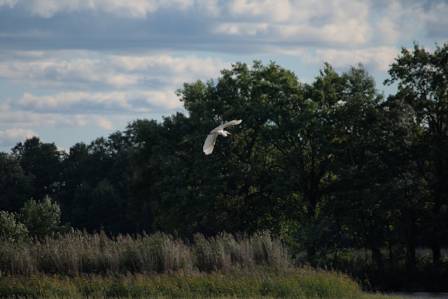
White herons typically fly with their necks retracted, unlike cranes and storks. Each species has a distinctive "GISS" (general impression of size and shape) that becomes recognizable with practice. Pay attention to feeding postures, movement patterns, and habitat preferences, as these behavioral cues often provide crucial identification clues. Age determination is also important, as critical field marks change with maturity.

Species Profiles

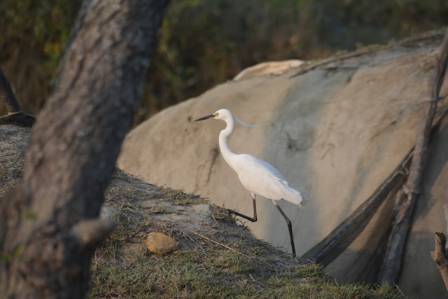
Snowy Egret

This medium-sized, slender heron favors estuarine shallows and employs varied hunting techniques, from animated pursuits to stationary vigils. Breeding adults display black bills with bright yellow lores and distinctive yellow feet, while nonbreeding birds show more subdued coloration. Immatures have greenish legs that darken with age, and their bill coloration transitions from dark-tipped with greenish base to adult appearance.

Great Egret

Consistent across all ages, this large heron features black legs and a stout yellow bill. It moves deliberately, often foraging with its bill held horizontally. Great Egrets lack head plumes, and breeding adults develop bright green lores and long back plumes. The species is widespread and commonly associates with other herons in mixed feeding flocks.

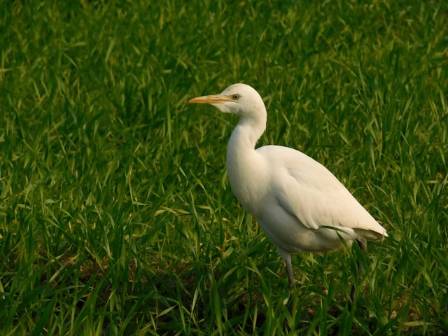
Cattle Egret

Distinctive for its compact shape with short neck and legs, this species prefers grassy habitats and often follows grazing animals. Breeding adults show rich buff-orange patches on head and neck, while nonbreeding birds are entirely white with yellow bills. Juveniles have black bills and legs initially, with bill color changing to yellow in their first fall.

Little Blue Heron (Juvenile)

First-year birds appear mostly white, creating identification challenges. They're slightly heavier than Snowy Egrets with thicker necks and bicolored bills. Note the dusky wingtips and generally sluggish movements compared to more active egrets. The white plumage provides an advantage when foraging with Snowy Egrets, as they're less likely to be driven away from feeding areas.

Reddish Egret (White Morph)

This uncommon coastal species shows acrobatic feeding behavior, including dramatic dashes and "canopy feeding" with wings spread. Adults have distinctive pink-based bills with dark tips, while immatures show mostly dark bills that gradually develop bicoloration. The white morph makes up only 2-7% of the Gulf Coast population.

Great White Heron

Restricted mainly to southern Florida, this largest heron features a heavy yellow bill and dusky pale legs. It prefers saltwater habitats and moves slowly and deliberately. Breeding adults develop slender head plumes. The "Wurdemann's" Heron represents hybrids between Great White and Great Blue Herons, showing intermediate characteristics.

Little Egret (Vagrant)

An accidental visitor from Eurasia, this species closely resembles Snowy Egret but is slightly larger with a more daggerlike bill. Breeding adults display two elongated head plumes rather than the shaggy plumes of Snowy Egrets. Nonbreeding birds show all-black legs and grayish lores, unlike the yellow lores of Snowy Egrets.
Mastering white heron identification requires attention to multiple characteristics including bill structure, leg color, plumage details, and behavioral patterns. With practice, observers can learn to distinguish these elegant birds confidently, enhancing their birding experience in wetland habitats throughout North America.

More from the edition

Column · en

10 Best Station wagon in 2025

Shopping for a new wagon in 2025? You’re part of a shrinking but savvy crowd. Although crossovers dominate driveways, station wagons quietly continue to offer a compelling mix of comfort, space, road manners, and style. Whether you want a family cruiser, a high-speed missile, or something that handles gravel trails with ease—this list has it.

Column · en

Exploring Pristine White-Sand Shores Across the Globe: A Collection of 10 Mesmerizing Beaches

Around the world, pristine white-sand beaches beckon tourists and locals alike with their powdery-soft shores and turquoise blue waters. While not quite as exciting as volcanic black-sand beaches or as rare as pink-sand beaches, white-sand beaches offer the quintessential seaside experience.

Column · en

Cherry Blossoms And Mount Fuji In Woodcut Prints

Have you ever been curious about how the vividly colored Japanese woodblock prints—known as ukiyo-e or hanga—are created? The printing methods behind these works were refined during the Edo period (1603–1868) and later became widely admired through the masterpieces of artists such as Katsushika Hokusai (1760–1849) and Utagawa Hiroshige (1797–1858).

Column · en

Top Ten Beach Towns for a Cottage by the Sea

If you dream of owning or staying in a cozy cottage by the ocean, these charming coastal towns are worth discovering. Away from the busiest tourist destinations, they offer peaceful beaches, beautiful landscapes, rich history, and relaxing seaside lifestyles. From quiet islands to historic waterfront communities, each destination provides its own unique coastal charm.

Column · en

Spring Kite Creative Painting For Children

No child should miss the chance to fly a kite on a grassy field. Sharing a kite-flying experience with parents can become a treasured memory in a child’s early years.

Column · en

The Speed Demons of the Animal Kingdom: Top 10 Swiftest Creatures on Earth

Human beings, despite their considerable intelligence and evolving technological prowess, remain considerably slower than many of their animal counterparts. The world is home to thousands of species that can outpace even the fastest human. While the maximum running speed of a human caps at approximately 27.5 miles per hour, several animals can effortlessly double that pace.