Sunday column
Easy Beginner's Guide To Painting A Squirrel
Painting a squirrel can be a fun and rewarding project, especially for beginners, as it provides a great opportunity to practice capturing the charm and intricate details of wildlife in art. To begin, gather your materials: acrylic or watercolor paints, a selection of brushes, a palette, and a painting surface such as paper or canvas.
Taylor Snow
Desk editor
Editor’s note
The full column continues in quiet type below.
Section
Sunday Broadsheet
Painting a squirrel can be a fun and rewarding project, especially for beginners, as it provides a great opportunity to practice capturing the charm and intricate details of wildlife in art. To begin, gather your materials: acrylic or watercolor paints, a selection of brushes, a palette, and a painting surface such as paper or canvas.
Start by lightly sketching the squirrel’s outline in pencil, paying attention to its rounded body, bushy tail, and key facial features. Using reference photos will help ensure accuracy. Begin painting with lighter tones for the base layer—think browns or soft grays—then gradually add shading and highlights to give depth and texture. Focus on the fur by applying short, layered strokes to replicate its natural flow. Finish with details like the eyes, nose, and claws to bring your squirrel to life. With patience, you’ll create a charming and realistic depiction of this playful woodland creature.
Gather Your Materials
Before starting your squirrel painting, collect all the necessary supplies:
Paints: Acrylics are ideal for beginners due to their quick drying time and ease of use. You can choose a set with primary colors (red, blue, yellow) and white to mix any shade for fur, eyes, and background. For convenience, pre-mixed earth tones such as browns, grays, and greens are perfect for squirrel paintings.
Brushes: A simple set works well. Include a flat brush for backgrounds, a round brush for details like the face and limbs, and a fine liner brush for whiskers or claws. Synthetic bristles are recommended as they handle acrylics well and are easy to clean.
Palette: Use a traditional palette, disposable paper palette, or even a ceramic plate for mixing colors.
Canvas or Paper: Beginners should start with a small to medium canvas (8x10 inches or 11x14 inches). Canvas panels or thick paper can also work for practice.
Reference Images: Have a high-quality photo of a squirrel to guide your proportions, posture, and fur texture.
Extras: Keep a cup of water for rinsing brushes, and paper towels for blotting and cleaning.
Set up your workspace so everything is within reach, ensuring a smooth, uninterrupted painting session.
Step 1: Sketch the Squirrel Outline
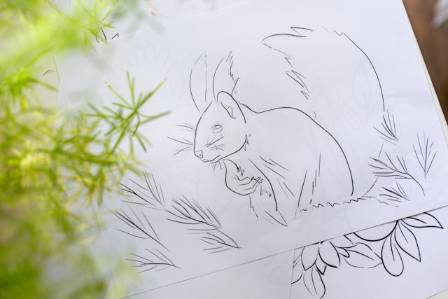
Start by lightly drawing the squirrel’s basic shape on your canvas or paper. Use an oval or rounded shape for the body and a smaller oval for the head. Observe your reference photo closely for accuracy.
Focus on the posture: is your squirrel sitting, climbing, or standing? Sketch the limbs naturally, keeping the hind legs slightly longer and muscular. Draw the tail with a gentle arch over the back, using flowing lines to capture its bushy texture.
Keep proportions realistic: the head is about one-third the size of the body, the eyes midway down the head, and triangular ears aligned with the top. Include subtle facial features—small almond-shaped eyes, a tiny nose, and whiskers. Keep your pencil strokes light so adjustments can be easily made. This sketch will serve as a guide for your painting.
Step 2: Apply the Base Coat
Prepare your canvas with a base coat, starting with a light color for the background—soft beige, pale yellow, or a muted green works well. Apply this evenly and allow it to dry completely before painting the squirrel to avoid accidental color blending.
For the squirrel’s fur, choose a medium brown or gray as the primary color. Using a flat brush, paint the body, leaving the eyes, nose, and other details for later. Apply thin layers, letting each dry before adding another to prevent muddy colors and ensure smooth coverage.
Paint the eyes and nose with a small brush. Use dark brown or black for the eyes, adding a tiny highlight for a lifelike sparkle. The nose can be painted in soft pink or light brown. Allow each layer to dry completely before moving on.
Step 3: Build Details and Texture
Once the base layer is dry, start adding fur texture with a fine brush. Use short, directional strokes that follow the natural growth of the fur. Layer darker and lighter shades to create depth, especially in dense areas like the tail. Vary your brush pressure and stroke length for a realistic, uneven look.
Incorporate highlights and shadows based on your imagined light source. Use lighter tones on raised areas and darker shades in recessed parts, such as under the belly, between legs, and within folds of the tail. Blend gently to avoid harsh transitions.
Refine the facial features: define the eyes with a dark pupil and bright highlight, add subtle shading to the nose, and paint thin, delicate whiskers. Don’t overwork these details to preserve their natural appearance.
Finally, include finishing touches: add light strokes to the ears, tips of the tail, and the claws. Tiny accents around the muzzle or soft dabs of color in the fur will enhance realism. Step back frequently to evaluate your painting, adding layers or refining transitions as needed.
Final Thoughts
Painting a squirrel is a process of patience and observation. By layering colors, building texture, and refining details, you can transform a simple sketch into a lifelike and captivating woodland creature. Take your time, enjoy the process, and watch your squirrel come to life on the canvas.
More from the edition
Column · en
8 Types of Orioles to Spot Across the United States
The term “oriole” traces back to a Latin word meaning “the golden one.” Though the name was first given to an unrelated group of birds in Europe, Asia, and Africa, it fits American orioles perfectly. These birds are part of the blackbird family—alongside grackles, red-winged blackbirds, and meadowlarks—and share the family’s characteristic sharply pointed beaks.
Column · en
The Comprehensive Manual for Men's Tailoring
In an era defined by casual remote work and shifting dress codes, the necessity of a suit might seem debatable. Paradoxically, this makes it the perfect time to invest in one. With social calendars filling up and a growing weariness of loungewear, the suit is experiencing a cultural renaissance. Modern fashion has liberated tailoring from rigid rules; it is no longer about the standard navy set but about bold pinstripes, classic houndstooth, and personal expression. Whether paired with a traditional silk tie or a vintage graphic tee, every man needs at least one exceptional suit.
Column · en
The Most Breathtaking Coastal Scenery in the World: Must-Visit Ocean Destinations
The ocean holds an irresistible allure for humans. We willingly invest time and money just to witness its vast, mesmerizing beauty. While we may never fully understand what draws us to the sea, one thing is certain—there are countless breathtaking ocean views around the world waiting to be discovered. If you're looking for some of the most spectacular coastal landscapes, we’ve handpicked several stunning locations, each offering a unique and unforgettable experience.
Column · en
Rugby Unveiled: A Novice's Handbook
For those new to the world of rugby union, the intricacies of the game might initially perplex. Questions may arise about the frequent halts in play, the distinction between a 'ruck' and a 'maul,' and the essence of a scrum in rugby. Fear not! Our rugby guide for beginners ensures that you swiftly grasp the fundamentals, transforming you into an avid spectator in no time.
Column · en
From Fiction to Function: 8 Technologies Shaping Our Future
The line between science fiction and scientific achievement is rapidly blurring. Innovations once confined to the pages of novels and movie screens are now emerging from laboratories and workshops, fundamentally changing how we live, work, and interact with the world. Here are eight technologies leading this transformation from speculative fantasy to tangible reality.
Column · en
Humongous Humpback Whale Facts
Humpback whales are among the most impressive creatures in the ocean. These enormous marine mammals are known for their incredible size, unique feeding techniques, long migrations, and unforgettable presence in coastal waters.