Sunday column
How to Tear Paper for Textured Edges
Creating a torn paper edge is a simple technique that can add texture, depth, and character to crafts such as card making, scrapbooking, and rubber stamping. Although tearing paper may seem effortless, using the right methods can help the effect appear intentional and polished rather than random. By understanding how paper behaves and practicing a few techniques, you can achieve attractive and consistent results.
Clara Winters
Desk editor
Editor’s note
The full column continues in quiet type below.
Section
Sunday Broadsheet
Creating a torn paper edge is a simple technique that can add texture, depth, and character to crafts such as card making, scrapbooking, and rubber stamping. Although tearing paper may seem effortless, using the right methods can help the effect appear intentional and polished rather than random. By understanding how paper behaves and practicing a few techniques, you can achieve attractive and consistent results.
Understanding How Different Papers Tear
Paper is made from compressed wood fibers. Papers with finer fibers tend to have a smoother surface and a tighter structure, while papers with coarser fibers often produce more texture when torn. When paper is cut with scissors or a craft knife, the fibers remain hidden, but tearing exposes them and creates a soft, textured edge.
Because papers are manufactured differently, each type responds uniquely when torn. Cardstock, construction paper, rice paper, watercolor paper, and handmade papers all produce distinct textures and appearances along the torn edge.
Many papers also reveal a different interior color when torn. Patterned, printed, or colored papers may have a core that contrasts with the surface, creating interesting visual effects and additional design opportunities.
Before using a paper in a finished project, it is helpful to experiment with scraps. Testing different materials allows you to see how they tear and what kind of edge or color variation they produce.
Techniques for Tearing Paper
By combining different tearing methods with various paper types, you can control the appearance of the finished edge and create the effect you want.
Practice Controlling the Tear
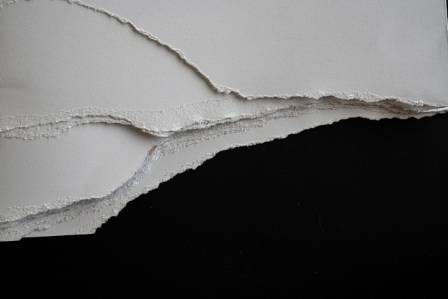
Begin with a few pieces of scrap paper and practice making tears. Most people naturally pull the paper toward themselves with their dominant hand, which influences the direction of the tear.
Try gently adjusting the direction as you tear. Pulling slightly left or right can change the shape and texture of the edge. Tearing slowly often produces a cleaner result, while tearing against the grain of the paper may reveal a rougher, more textured edge.
Each paper behaves differently. Handmade papers, for example, often contain visible fibers that create highly textured, organic-looking edges. These natural variations are part of what makes torn-paper techniques visually appealing.
When tearing around a stamped image, illustration, or printed design, leave extra space around the artwork. This gives you room to refine the shape later without accidentally damaging the image.
Using Water as a Tearing Guide
If you need a more controlled and precise tear, use water as a guide. Apply a thin line of water along the area where you want the paper to separate. Allow the moisture to soak into the fibers for a minute or two.
Once the paper is damp, gently tear along the wet line. The weakened fibers will naturally guide the tear, helping you achieve a cleaner and more predictable edge.
Enhancing Torn Edges
The exposed texture of a torn edge can be emphasized to create additional depth and dimension. Lightly applying ink, chalk, or other coloring mediums along the edge helps highlight the fibers and make the effect more noticeable.
Watercolors can also be used to create a soft, aged appearance that resembles vintage or weathered paper. Before applying any coloring technique to a finished project, test it on scrap paper to become familiar with the effect and ensure it complements your design.
With a little practice and experimentation, torn paper can become a versatile design element that adds texture, contrast, and visual interest to a wide range of creative projects.
More from the edition
Column · en
The 7 Most Shocking Truths About Seagulls You Never Knew
Despite the name "seagull," many have abandoned coastal living for urban landscapes and landfill sites. These areas provide an endless, easy-access buffet. While their natural diet includes mollusks, small fish, and insects, they are ultimate opportunists—readily consuming other birds' chicks and eggs, roadside carrion, or your discarded fries. Their primary culinary rule? Minimum effort, maximum reward.
Column · en
How to Choose the Ideal Suit for Your Body Type
A poorly fitted or ill-suited suit can instantly undermine your sense of style. All too often, we see men wearing jackets that are too baggy, too long, or hopelessly out of date—mistakes that can easily be avoided.
Column · en
Top 5 National Forests to Explore This Winter
Let’s face it—getting outdoors in winter can feel like a challenge. The idea of bundling up and braving the cold often loses to the warmth of blankets and a second (or third) tap on the snooze button. But with a little planning, a thermos full of strong coffee, and the promise of snow-covered beauty, some national forests transform into stunning winter destinations worth the effort. Here are five national forests that offer unforgettable experiences when the temperature drops.
Column · en
Pronghorn: Racers on the Great Plains
Badlands National Park provides a home for the pronghorn, which is sometimes called the pronghorn antelope. Despite its nickname, the pronghorn is not actually a true antelope. However, it shares several characteristics with genuine antelopes found in Africa and Asia. These similarities are the result of convergent evolution, in which unrelated animals independently develop comparable traits because they face similar environmental conditions. The pronghorn is the only surviving species in the family Antilocapridae, and its closest living relatives are actually giraffes.
Column · en
Japanese Daifuku: Taste and Tips
Daifuku is one of Japan’s most beloved traditional sweets, treasured for its soft, chewy mochi (glutinous rice cake) exterior and subtly sweet anko (red bean paste) filling. But did you know that daifuku comes in many variations? This dessert has evolved into a treat with countless flavors and textures.
Column · en
Sculpted by the Sea: The Dynamic Geology of Rocky Coastlines
The relentless pounding of surf and breaking waves has shaped rocky coasts into some of the most dramatic landscapes on Earth. Characterized by high-energy erosion, these coasts are typically found along active tectonic margins with narrow continental shelves. Composed of sedimentary, igneous, or metamorphic rock, they bear witness to complex geological processes, including faulting, folding, and volcanic activity. The specific profile of a rocky coast—whether steep cliffs or gentle slopes—is dictated by the interplay of bedrock resistance, climate, and wave energy. For instance, the resistant lava flows of Kalaupapa National Historical Park (Hawaii) create towering sea cliffs, while the more erodible limestones of Dry Tortugas National Park (Florida) form gentler slopes. Glacial activity further sculpts these regions, carving deep fjords and depositing talus slopes, while carbonate coasts can lithify into eolianite dunes that later erode into steep bluffs.