Sunday column
The Fascinating History of the Gouldian Finch
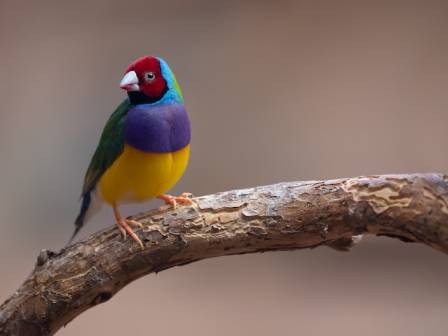
Although it is widely known today simply as the Gouldian finch, this stunning bird originally carried the name “Lady Gouldian Finch.” The name was given in 1845 by the famous British ornithologist John Gould. Like many people who encounter this bird for the first time, Gould was deeply impressed by its extraordinary beauty and chose to honor the memory of his late wife by naming the species after her.
Emma Sinclair
Desk editor
Editor’s note
The full column continues in quiet type below.
Section
Sunday Broadsheet
Although it is widely known today simply as the Gouldian finch, this stunning bird originally carried the name “Lady Gouldian Finch.” The name was given in 1845 by the famous British ornithologist John Gould. Like many people who encounter this bird for the first time, Gould was deeply impressed by its extraordinary beauty and chose to honor the memory of his late wife by naming the species after her.
The Gouldian finch is a small seed-eating bird measuring around 5 inches from the tip of its beak to the end of its tail. It belongs to the Estrildidae family of finches. This colorful species is native to Australia, where it naturally inhabits the northern regions of the country, including the Kimberley area of Western Australia, the Northern Territory, and northern Queensland.
Once abundant in the wild, Gouldian finch populations experienced a significant decline during the 20th century. Today, fewer than 2,500 mature wild individuals are estimated to remain, causing the species to be classified internationally as near threatened.
The Natural Color Variations of the Gouldian Finch
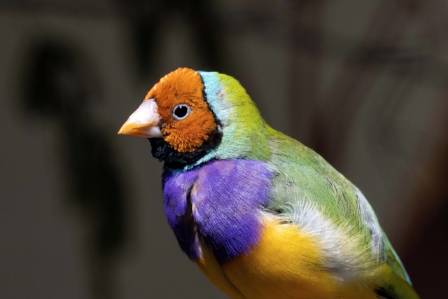
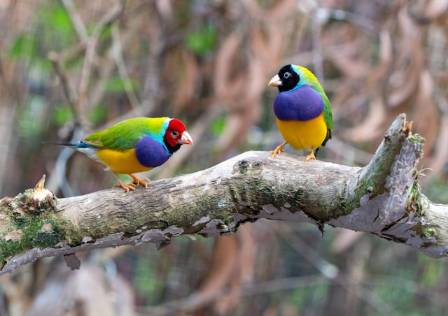
When Gouldian finches were first discovered, scientists were uncertain whether the different head colors represented separate species or simply variations within the same species. Three naturally occurring head-color types are found in wild populations: black-headed, red-headed, and yellow-headed Gouldian finches. Although called yellow-headed, this variety often appears more orange than yellow.
Both male and female Gouldian finches can display any of these three natural head colors. Over time, researchers confirmed that these color differences are not separate species but rather different genetic forms, or morphs, of the same bird.
The Evolution of Different Head Colors
Among wild Gouldian finches, the black-headed variety is the most common, making up approximately 70% of the population. Red-headed birds account for around 30%, while yellow-headed individuals are extremely uncommon, with estimates suggesting only one bird in every thousand may have this coloration.
Scientists believe these different color forms developed as a result of long-term environmental changes. Many generations ago, shifts in climate separated the ancestors of Gouldian finches into three isolated groups located in different northern regions of Australia: Western Australia, the Northern Territory, and Queensland’s Cape York Peninsula.
As these populations remained separated, they gradually developed unique physical traits, including different head colors. Later, as wetter conditions caused grassland habitats to expand southward, the three populations came back into contact with one another. The existence of these three distinct color forms provides an excellent example of how species can gradually evolve over long periods of time.
Lifespan of the Gouldian Finch
Gouldian finches raised in captivity typically have an average lifespan of around 5 to 6 years. However, birds that receive excellent care can often live much longer, and some captive individuals have been known to reach 9 years of age.
Wild Gouldian finches generally have shorter lives due to the challenges of survival in nature. Predators, seasonal food shortages, and periods of drought all create difficult conditions. Compared with wild birds, captive Gouldian finches benefit from stable food supplies, protection, and better living conditions, which can contribute to their longer lifespan.
How to Identify Male and Female Gouldian Finches
Determining the sex of a Gouldian finch is relatively straightforward because males and females have noticeable differences in appearance. The male, or cock bird, usually has much brighter and more vivid coloring, while the female, or hen, displays softer and more muted tones.
The difference is especially visible on the breast. Males typically have a deeper purple or dark violet breast color, while females usually show lighter pink or pale purple shades. Males also tend to have brighter blue markings and longer tail feathers compared with females.
In red-headed and yellow-headed Gouldian finches, males usually have a much brighter and more strongly colored facial mask than females, making identification easier.
Vocal Differences Between Male and Female Gouldian Finches
Gouldian finches can also be identified by their sounds. Both males and females communicate through various calls, chirps, and tweets, but only the male produces the characteristic singing behavior.
Male Gouldian finches have different levels of singing ability, with some producing more complex and attractive songs than others. However, their unique whistles and melodies make it relatively easy to distinguish a singing male from a female.
Gouldian Finch Mutations in Captivity
Over the years, bird breeders have developed and documented several Gouldian finch color mutations. The most common mutation is the white-breasted variety. These birds lack the normal pigmentation on their breast but otherwise maintain typical feather patterns and colors. This mutation can occur in both males and females.
Other recognized Gouldian finch mutations include silver, dilute, yellow-backed, and blue varieties. Some mutations make it easier to determine the bird’s sex based on appearance, while others require closer observation or listening to vocal behavior.
Despite their differences in coloration, all Gouldian finch mutations remain part of the same beautiful species and continue to attract bird enthusiasts around the world.
More from the edition
Column · en
10 Giraffe Facts
Giraffes live in the dry savannahs of Africa, roaming open plains and woodlands.
Column · en
Essential Steps for Starting a Successful Balcony Garden
Growing a personal vegetable garden filled with fresh greens, aromatic herbs, or bright cherry tomatoes is a wonderful aspiration. Even if you lack a traditional backyard, a lack of extensive outdoor acreage should not prevent you from cultivating a thriving green space. Apartment residents can easily transform an underutilized patio or balcony into a lively and joyful sanctuary. Urban container gardening allows you to experience all the therapeutic and practical benefits of agricultural production within a small footprint. All you truly need to begin this rewarding journey is a sturdy balcony railing, a selection of appropriate containers, a few basic tools, and a willingness to learn and experiment with nature.
Column · en
Sago Palm: The Ancient Plant That Isn’t Really a Palm
During a recent trip to the warm, sunny South, I had the opportunity to reacquaint myself with palm-like plants. Like many people from northern regions, my knowledge of palms is fairly limited. One plant, however, has always caught my attention: the Sago Palm. Although its appearance strongly suggests that it belongs to the palm family, it is actually much more closely related to pine trees.
Column · en
A Beginner's Guide to Tea
For people who already enjoy it, tea is a comforting and versatile drink suitable for almost any moment. However, for beginners, tea can seem like an incredibly complex world filled with countless varieties, aromas, and flavor combinations. There is much more to tea than simply choosing a box from a supermarket shelf.
Column · en
Bluestone Bridge
As you cross the present-day Blue Stone Bridge and listen to the peaceful flow of Wissahickon Creek beneath you, it is difficult to imagine how lively and heavily traveled this same spot once was.
Column · en
Best 6 Best Luxury Silk Scarves to Buy
A number of prestigious fashion houses are known for creating exceptionally beautiful and high-quality silk scarves. Among the most notable names are the following.