Sunday column
How to Paint a Mountain Lake Sunset
In this tutorial, I’ll guide you through painting a mountain lake sunset, inspired by the stunning views of Lake Wanaka in New Zealand. This landscape features autumn trees, towering mountains, a calm lake, and the evening sun peeking through clouds.
Ruby June
Desk editor
Editor’s note
The full column continues in quiet type below.
Section
Sunday Broadsheet
In this tutorial, I’ll guide you through painting a mountain lake sunset, inspired by the stunning views of Lake Wanaka in New Zealand. This landscape features autumn trees, towering mountains, a calm lake, and the evening sun peeking through clouds.
Throughout this process, I’ll share tips on capturing autumn colors, creating realistic sunsets and clouds, and achieving harmonious color balance. This tutorial works well for both oil and acrylic paints.
Paint Colors
For this piece, I used oil paints in the following colors:
Titanium White
Burnt Sienna
Yellow Oxide (or Yellow Ochre)
Cadmium Yellow
Cadmium Orange
Quinacridone Crimson (or Alizarin Crimson)
Ultramarine Blue
Phthalo Green
Brushes Used
No. 5 Flat
No. 3 Flat
No. 2 Flat
No. 3 Filbert
No. 1 Round
No. 0 Round
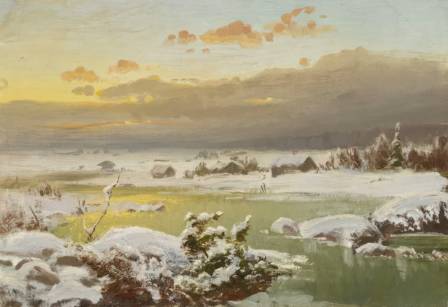
Stage One – Blocking In
I painted this on a 10” x 12” linen panel, which is pre-stretched and oil-primed with a medium weave.
I started with a loose sketch using a No. 1 round brush, mixing Burnt Sienna with Liquin Original to thin the paint. Liquin also speeds up drying time, which is helpful for layering.
Paint Your Darks First
I always begin with the darkest values and shadows. Understanding value—how light or dark an area is—helps to create depth and atmosphere in the painting. Shadows and highlights are strongest in the foreground, while values soften as forms recede into the distance.
For distant mountains, I mixed Ultramarine Blue, Burnt Sienna (to dull the blue), Titanium White (to adjust value), and a touch of Quinacridone Crimson for a violet tint.
In the foreground bushes, I combined Ultramarine Blue with Yellow Oxide for the darker tones. For the rusty foliage of the Lombardy poplars, I used a mix of Yellow Oxide, Quinacridone Crimson, and Ultramarine Blue.
I established the tonal structure by blocking in the major areas: sky, lake, mountains, trees, grass, and rocks. Using similar colors throughout ensures color harmony and makes the painting feel unified.
Grass in the foreground was painted using Yellow Oxide, Quinacridone Crimson, Ultramarine Blue, and Titanium White—the same combination as the trees, but lighter in value. The mid-ground mountains used a similar mix but slightly darker.
Rocks and stones were painted with Ultramarine Blue, Burnt Sienna, Quinacridone Crimson, and Titanium White.
The sun and the orange glow in the clouds were achieved using Yellow Oxide, Quinacridone Crimson, and Titanium White. Initially, I added some Cadmium Yellow but later painted over it as it was too intense.
For the lake, reflecting the sky, I used a simple mix of Ultramarine Blue, Yellow Oxide, and Titanium White. The orange glow on the water was painted with the same mix as the clouds. After blocking in, I allowed the painting to dry before moving on.
Stage Two – Modeling and Adding Details
In this stage, I refined the shapes and added detail, keeping the same color palette from the blocking-in stage. I gradually built up lighter values to create dimension and depth.
I adjusted the foreground trees and grass to make them richer in value while maintaining the original color mix (Yellow Oxide, Quinacridone Crimson, Ultramarine Blue).
The glow in the clouds was enhanced, blending Titanium White and Yellow Oxide for the brightest highlights where the sun breaks through.
Green foliage on bushes and Lombardy poplars was painted using Ultramarine Blue, Yellow Oxide, Cadmium Yellow, Cadmium Orange, Titanium White, and sometimes a touch of Phthalo Green to vary the hue.
Flat brushes were mainly used for the trees and grass, while filbert brushes helped create the textured foliage marks.
Stage Three – Final Details
After allowing the painting to dry again, I added the final touches using the lightest values.
The brightest sunlight was layered with Titanium White and a small amount of Yellow Oxide. Highlights on the Lombardy poplars were added using Titanium White, Yellow Oxide, and a little Quinacridone Crimson.
I suggested the structure of main stems and branches using Ultramarine Blue, Burnt Sienna, and a touch of Titanium White.
Finally, I added small details to the grass and vegetation to complete the painting, enhancing realism and depth.
This method allows for a structured approach to painting sunsets, mountains, and autumn landscapes, while giving flexibility to create your own interpretation of Lake Wanaka’s stunning scenery.
More from the edition
Column · en
The least trustworthy 3D printer brand is still the best
Bambu Lab has come to represent two very different sides of the 3D printing industry. On one side, it is an exceptionally successful company that brought 3D printing to a much broader audience by making the technology easier to use, more approachable, and more affordable. On the other, it has adopted strategies reminiscent of companies such as Apple and Nintendo, building a tightly controlled ecosystem and using its legal resources to protect that ecosystem.
Column · en
Types of Crab Featured
The article highlights seven crab types prized for their flavor, texture, and culinary appeal.
Column · en
All true spider monkeys are on the verge of extinction.
Spider monkeys belong to the genus Ateles and are easily recognized by their extremely long limbs and curved, hook-shaped hands.
Column · en
The Secret Life of Clownfish and Their Incredible Underwater Alliances
The ocean hides many colorful wonders. The clownfish ranks among the most famous marine creatures. Scientists place this vibrant animal in the kingdom Animalia and the phylum Chordate. It belongs to the class Actinopterygii and the order Perciformes. Its official family name is Pomacentridae. The genus is called Amphiprion. These small fishes possess striking appearances. They can display many brilliant hues depending on their specific species. Some appear bright yellow or deep orange. Others showcase radiant red or solid black bodies. Most individuals feature distinct white markings that contrast beautifully with their main body color. They generally remain quite small throughout their lives. The absolute smallest individuals measure roughly seven to eight centimeters in length. The largest specimens can grow up to seventeen centimeters long.
Column · en
Exploring the Top 5 Snow capped mountains in the world
Some of the most extraordinary landscapes on Earth are found in high-altitude mountain systems covered in snow. These dramatic regions inspire awe, offer unforgettable travel experiences, and hold deep cultural and historical value. In this article, we explore five of the world’s most remarkable snow-covered mountain ranges. From the towering Himalayas to the expansive Andes, each range presents unique scenery, ecosystems, and traditions shaped over centuries.
Column · en
Raccoons — Facts and Fancies
The raccoon (Procyon lotor) is a member of the carnivore order, a group of mammals that mainly consume meat but may also eat plant materials such as berries, fruits, vegetables, eggs, acorns, beech nuts, hickory nuts, grains, grasses, and tree bark when other food sources are limited. Like other carnivores, raccoons have five toes on each foot and large canine teeth. However, raccoons are omnivorous animals, and the balance between plant and animal foods in their diet changes depending on the season and available resources.