Sunday column
A Beginner's Guide to Floral Painting: Six Simple Steps
Creating a floral masterpiece is a rewarding journey that offers both relaxation and a creative outlet. This guide provides a clear, structured path for beginners to transform a blank surface into a vibrant flower. By following these foundational steps, anyone can enjoy the process of bringing a piece of nature to life through art.
Jason Patrick Montgomery
Desk editor
Editor’s note
The full column continues in quiet type below.
Section
Sunday Broadsheet
Creating a floral masterpiece is a rewarding journey that offers both relaxation and a creative outlet. This guide provides a clear, structured path for beginners to transform a blank surface into a vibrant flower. By following these foundational steps, anyone can enjoy the process of bringing a piece of nature to life through art.
Organizing Your Creative Space and Materials
Before the first stroke of paint, preparation is essential. Selecting the right medium is the first decision: acrylics are favored for their thick consistency and rapid drying time, while watercolors offer a lighter, translucent quality that relies on water for blending. Alongside your paints, assemble a variety of brushes, including larger flats for broad backgrounds and fine rounds for intricate details. You will also need a palette for mixing, a water container, and a dedicated surface such as a canvas or specialized watercolor paper. Keeping a pencil, eraser, and cloth nearby ensures you can adjust your work as you go.
The physical environment also plays a role in your success. A well-lit, organized workspace allows for a steady creative flow. Arranging materials within easy reach prevents interruptions. Utilizing a reference photo—such as a daisy, tulip, or sunflower—serves as a vital guide for understanding proportions and tonal variations.
The Foundation: Sketching and Base Layers
The painting process begins with a light pencil sketch. Focus on basic geometric shapes to establish the proportions of the petals and center. For example, a sunflower can be simplified into a large central circle surrounded by elongated ovals. This sketch serves as a non-permanent roadmap, so perfection is not required at this stage.
Once the outline is ready, apply the base layer. This involves painting the primary color of the petals using a small brush. If your medium is acrylic or gouache, the general rule is to work from dark colors to light. In contrast, watercolor artists typically work from light to dark. Once this initial layer is dry, you can begin adding depth. Use different tints and shades to establish highlights where the light hits and shadows where petals overlap. This contrast is what gives the flower a three-dimensional, realistic appearance.
Completing the Composition: Backgrounds and Variations
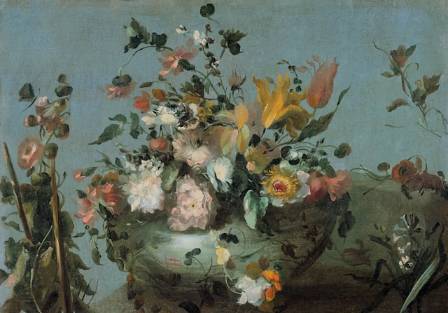
The background is a powerful tool to make your subject stand out. Choosing a color that contrasts with your flower—such as a soft blue or green to offset warmer reds and oranges—creates a professional finish. Use a large brush and consistent strokes to cover the area. For a more dynamic look, blend multiple hues to suggest a sky, a garden, or a soft-focus meadow.
As you grow more confident, consider exploring different floral structures to expand your skills:
-
Roses: Focus on tight central layers that gradually expand outward.
-
Lilies: Use sweeping, smooth strokes to capture their elegant, curved silhouettes.
-
Hydrangeas: Apply small, dappled brushstrokes to mimic clusters of tiny blooms.
-
Orchids: Pay close attention to unique patterns and delicate, exotic textures.
Final Refinements and Preservation
The final stage involves mastering techniques that add character to your work. The "wet-on-wet" method allows for soft, blended edges, while "dry brushing" is excellent for creating a weathered or organic texture. Always save your brightest highlights for the very end to ensure they remain crisp and luminous.
After the painting is finished, allow it to dry completely—a process that can take several hours for acrylics. To protect the surface and keep the colors vibrant over time, you may choose to apply a clear varnish. This optional step seals the artwork and provides a professional sheen. Beyond the canvas, these skills can be applied to various projects, such as decorating pottery, designing personalized cards, or creating unique textile patterns.
More from the edition
Column · en
Understanding the Nature of Grasslands
Before identifying the globe’s most expansive grasslands, it's essential to clarify what constitutes a grassland. These ecosystems are immense open regions where the primary vegetation is grass, stretching across vast distances. Grasslands typically form in regions where rainfall is moderate—not sufficient to support forests but enough to prevent the terrain from becoming a desert. They are characteristic of zones with semi-dry to semi-wet climates.
Column · en
Wooden Alarm Clocks That Enhance Your Home Decor
Anjankstore is a home-products brand focused on creative, practical, and attractive items that can add both convenience and personality to your living environment. One of its notable products is the Wooden Digital Alarm Clock, which combines useful everyday functions with a natural decorative style.
Column · en
5 Spanish Castles You Can Stay In
Across Spain, the countryside is filled with ancient castles and palaces that have watched over towns and villages for hundreds of years. Although kings, queens, and nobles no longer inhabit these historic buildings, many of them have been carefully restored and transformed into unique hotels. Staying in one of Spain’s Paradores offers the rare chance to step directly into history and experience life in a medieval or Renaissance setting. Here are five remarkable castle hotels where guests can enjoy a truly royal stay.
Column · en
The World of Sea Turtles
Sea turtles are reptiles that spend their lives in the ocean and travel through waters across much of the world. They belong to the turtle family but are distinct from turtles that live primarily on land or in freshwater environments. There are seven recognized species of sea turtles: leatherbacks, green turtles, hawksbills, loggerheads, olive ridleys, Kemp’s ridleys, and flatbacks. These remarkable animals have existed for more than 100 million years and can be found in nearly every ocean, with the exception of the polar seas. Leatherback turtles, however, are capable of traveling into surprisingly cold and far-northern waters.
Column · en
The Grand Foundation and Early Origins of the Royal Ontario Museum
The Royal Ontario Museum was officially founded on April sixteenth in nineteen hundred and twelve through the joint administration of the Ontario provincial government and the University of Toronto. Initial collections were transferred from the academic institution and the local department of education originating from a predecessor facility located at the Toronto Normal School. His Royal Highness the Duke of Connaught who served as the governor general of Canada formally opened the institution to the general public on March nineteenth in nineteen hundred and fourteen. The chosen site sat along the periphery of the urban area distant from the downtown core selected specifically for its close adjacency to the main university campus. The original architectural footprint arose on the western boundary adjacent to Philosopher's Walk featuring a primary entryway facing Bloor Street and encompassing five distinct disciplines covering archaeology palaeontology mineralogy zoology and geology. Construction expenses reached four hundred thousand dollars marking the initial stage of a larger master plan intended to stretch toward Queen's Park Crescent and form an imposing symmetrical layout.
Column · en
Authentic Thai Mango Sticky Rice
Thai mango sticky rice is a globally adored dessert that combines the tropical sweetness of ripe mangoes with the rich, comforting texture of coconut-infused glutinous rice. Known in Thailand as kao niew mamuang, this dish relies on a delicate balance of sweet and salty flavors. While the classic version is brilliant white, modern variations often feature vibrant, naturally dyed rice.