Sunday column
From Sputnik to Firefly: The Fascinating World of Satellites
On October 4, 1957, the announcement “T-minus 10 minutes” echoed through an underground bunker at the Baikonur Cosmodrome in Kazakhstan. Only about 200 meters away, a massive 29-meter R-7 rocket stood on the Tulip launch pad. Its unusual payload was a polished, basketball-sized sphere weighing 83.6 kilograms.
Mireya Solen
Desk editor
Editor’s note
The full column continues in quiet type below.
Section
Sunday Broadsheet
On October 4, 1957, the announcement “T-minus 10 minutes” echoed through an underground bunker at the Baikonur Cosmodrome in Kazakhstan. Only about 200 meters away, a massive 29-meter R-7 rocket stood on the Tulip launch pad. Its unusual payload was a polished, basketball-sized sphere weighing 83.6 kilograms.
That payload was Sputnik 1, the first artificial satellite ever launched into space. Its successful launch represented a major turning point in human history, opening the Space Age and intensifying the Space Race between the United States and the Soviet Union.
Sputnik’s distinctive radio transmissions became an unmistakable symbol of Soviet technological achievement and demonstrated that humanity had entered a new era of space exploration.
From that first simple satellite to the highly sophisticated spacecraft operating today, satellite technology has undergone an extraordinary transformation. What began with a relatively basic orbiting sphere has developed into a technology that has fundamentally changed how we study Earth and understand the universe.
What Is a Satellite?
A satellite is an object that travels around a planet or star. Satellites can be natural, such as Earth's Moon, or artificial objects created and launched by humans.
Artificial satellites are generally designed to operate around Earth, although some are sent to other worlds to perform specific missions. The Mars Orbiter Mission, for example, was developed to operate around Mars.
Depending on their purpose, artificial satellites can be used for Earth observation, communications, navigation, scientific investigation, imaging, and many other applications.
A Brief History of Satellites
How did humanity progress from theoretical ideas about orbital motion to the sophisticated satellites operating today? Several important scientific and technological developments helped establish the foundation.
1. Newton's Pioneering Ideas
Isaac Newton laid some of the earliest theoretical groundwork for artificial satellites in his work “A Treatise of the System of the World.” Among his famous thought experiments was the idea of firing a cannonball from a high mountain and examining what would happen at different launch speeds.
Newton proposed that the outcome would depend on how quickly the cannonball was launched. At relatively low velocities, it would simply fall back toward Earth. At higher speeds, it could travel along an elliptical path around the planet. If its velocity became high enough to exceed Earth's escape velocity, it could break free from Earth's gravitational influence.
This thought experiment demonstrated the fundamental relationship between velocity and gravity and provided an early theoretical basis for the concept of an artificial satellite.
2. Tsiolkovsky's Influence
Konstantin Tsiolkovsky, a Russian and later Soviet scientist, is widely remembered as the “Father of Spaceflight.” His theoretical work established important foundations for future space exploration and rocket engineering.
In 1903, Tsiolkovsky described fundamental principles of rocket propulsion and space travel. One of his most significant contributions was the idea of using multistage rockets to carry payloads into Earth orbit.
The concept became an essential part of later rocket development because multiple stages allow a launch vehicle to discard mass during flight and achieve the velocity required for orbital operations.
3. Clarke's Vision and the Modern Satellite Era
During the middle of the 20th century, science fiction author Arthur C. Clarke made an important contribution to the development of satellite communications.
In his 1945 essay “Extraterrestrial Relays,” Clarke described the possibility of placing a satellite in an orbit where it would travel around Earth at the same rate as the planet rotates.
At an altitude of approximately 35,786 kilometers above Earth's surface, such a satellite would appear to remain stationary relative to a particular point on the ground. This type of orbit could allow the spacecraft to function as a relay station for telecommunications signals.
Clarke's concept helped establish the theoretical foundation for modern geostationary communication satellites and transformed the way scientists and engineers thought about global communications.
What Does a Satellite Consist Of?
A typical satellite contains electrical, mechanical, and chemical components that work together to perform its mission. These components are generally organized into several major subsystems.
Attitude and Orbit Control Subsystem
The attitude and orbit control subsystem keeps the spacecraft properly oriented and helps maintain its intended position and trajectory in space. Components such as reaction wheels and magnetorquers can be used to control the satellite's orientation.
Electrical and Electronics Subsystem
The power subsystem supplies electricity to the satellite's other systems. Solar panels are a common source of energy, allowing the spacecraft to convert sunlight into electrical power.
The communication subsystem handles the transmission and reception of information. Antennas allow the satellite to exchange data with ground stations and other systems.
Thermal Control Subsystem
The thermal control subsystem keeps the spacecraft within acceptable temperature ranges. Heaters and radiators help protect sensitive equipment from the extreme temperature variations encountered in space.
Structural Subsystem
The structural subsystem provides the satellite with its physical framework and ensures that it can withstand the intense forces experienced during launch and normal operation. It includes the main frame, supports, and other structural components.
Mission Planning and Dynamics
Mission planning and dynamics involve determining and managing the satellite's orbital path, movement, and operational activities. Accurate planning and control help the spacecraft perform its intended mission as efficiently as possible.
Notable Satellites and Their Breakthroughs
The CORONA program operated from 1959 through 1972 and involved highly classified reconnaissance satellites equipped with high-resolution cameras. The spacecraft were used to gather intelligence on the Soviet Union during the Cold War.
Photographic film was returned to Earth inside capsules that were dropped from the satellites and recovered in midair. Because the program was classified for many years, the public did not learn the full details until information was officially acknowledged decades later.
Voyager 1
NASA launched Voyager 1 in 1977 to investigate the outer solar system and eventually travel beyond it. After more than four decades in space, it became the farthest human-made object from Earth.
Voyager 1 also carries the Golden Record, a collection of sounds, images, and other representations of life on Earth. The record was intended as a message that could potentially be discovered by intelligent life elsewhere in the universe.
Hubble Space Telescope
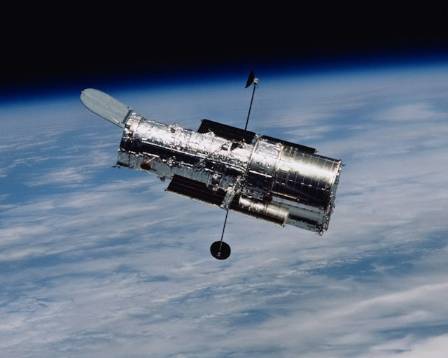
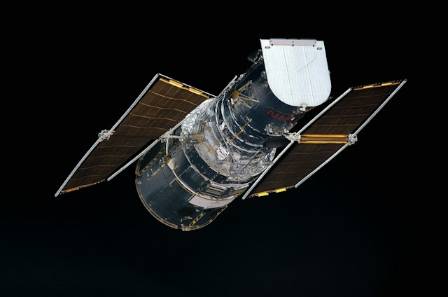
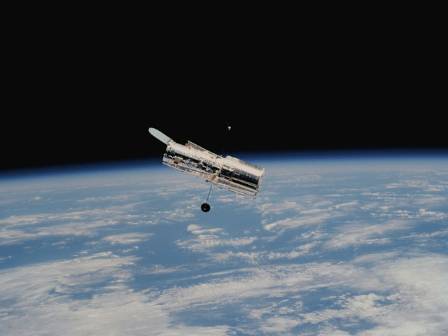
The Hubble Space Telescope was named after astronomer Edwin Hubble and launched in 1990 through a collaboration between NASA and the European Space Agency.
With a primary mirror measuring 2.4 meters, Hubble operates in low Earth orbit and has captured extremely detailed images of astronomical objects. Its observations have transformed modern astronomy and contributed to major discoveries, including evidence that helped scientists understand dark energy.
Hubble initially experienced a serious problem with its primary mirror, which caused its first images to appear blurred. Astronauts corrected the problem during a servicing mission in 1993, after which the telescope was able to produce remarkably sharp observations.
Among its most famous achievements is the Hubble Ultra Deep Field, which revealed thousands of distant galaxies within a very small region of the sky.
Cassini
The Cassini spacecraft was launched in 1997 to explore Saturn and its moons. During its mission, it discovered new moons and conducted numerous close encounters, including important observations of Titan.
The mission concluded in 2017 when Cassini entered Saturn's atmosphere. The enormous amount of information collected during its journey provided scientists with important insights into Saturn's rings, atmosphere, moons, and the possibility that some of its moons could potentially support conditions relevant to life.
James Webb Space Telescope
The James Webb Space Telescope was launched in 2021 through a collaboration involving NASA, the European Space Agency, and the Canadian Space Agency.
Designed to build upon and extend the astronomical capabilities of Hubble, JWST focuses on subjects including the earliest galaxies in the universe and the atmospheres of planets orbiting other stars.
The telescope operates near the second Lagrange point, or L2, approximately 1.5 million kilometers from Earth. Its primary mirror measures 6.5 meters, giving it powerful capabilities for observing faint and distant astronomical objects.
A New Era of Satellite Technology
The development of satellites has progressed from early theoretical concepts to increasingly sophisticated systems capable of studying Earth, exploring distant worlds, and examining the origins of the universe.
One emerging area is hyperspectral imaging. Pixxel's planned hyperspectral satellite constellation represents this new generation of Earth-observation technology.
Hyperspectral satellites can collect information across many different portions of the electromagnetic spectrum while also providing detailed spatial observations. This combination can reveal characteristics of materials and environments that conventional imaging may not detect.
The technology has potential applications in agriculture, environmental observation, natural resource exploration, and many other fields.
As satellite technology continues to advance, future spacecraft will provide increasingly detailed information about our planet while expanding our ability to investigate the solar system and the universe beyond it.
More from the edition
Column · en
5 Enjoyable Cycling Tours for a Two-Wheel Vacation
Exploring a new destination on a bike lets you fully immerse yourself in the surroundings while getting your heart rate up. These five exciting cycling tours will have you gliding past stunning scenery, soaking up the sunshine, and breathing in fresh air as you discover new places.
Column · en
The Most Beautiful and Magical Desert on Earth — Brazil’s Desert
The world is filled with extraordinary places and rare natural phenomena that seem almost impossible to imagine. One of these remarkable landscapes can be found in Brazil, where vast white sand dunes surround crystal-clear lagoons in shades of turquoise and blue-green. The water is so transparent that the bottom can often be seen, while fish and shrimp move beneath the surface. When the sun begins to set, the entire landscape takes on an even more spectacular appearance. The result looks almost like a paradise created on Earth.
Column · en
Ultimate Guide to the Stunning Sky High Adventures in Lujiazui Shanghai
Welcome to the dazzling core of the financial hub of Shanghai, where the spectacular cityscape serves as an incredible display of contemporary design and technological advancement. When you arrive in this energetic neighborhood, you will encounter a magnificent collection of soaring structures that define the city line while showcasing incredible engineering ambition. From the grand twisting mega towers to the distinctive spherical structures, this destination remains an essential stop for anyone wanting to see the absolute finest sights in the region.
Column · en
The dead leaf butterfly: Master of camouflage
The dead leaf butterfly (Kallima inachus) is a remarkable example of natural camouflage. When its wings are folded, their appearance closely resembles that of a dried leaf, complete with dark vein-like patterns that help the butterfly disappear among fallen foliage.
Column · en
Discovering the Blue Morpho Butterfly: A Marvel of Nature
The Blue Morpho butterfly, scientifically identified as Morpho menelaus, is among the most spectacular and easily recognizable butterflies on Earth. Its brilliant, shimmering blue wings create an unforgettable appearance and have fascinated people for generations. Visitors can also observe these remarkable butterflies at The Butterfly House at Navy Pier in Chicago.
Column · en
Fun Facts About Penguins
Penguins are among the most delightful and captivating creatures on the planet, boasting incredible adaptations for life in the ocean and social behaviors that feel surprisingly familiar.