Sunday column
The 10 Greatest Impressionist Landscape Paintings
The Impressionist movement revolutionized 19th-century art, breaking away from classical traditions to focus on light, color, and the transient beauty of the natural world. Landscapes became the ideal subject for artists to experiment with these innovations. Below, we explore ten of the most remarkable Impressionist landscape paintings, examining their techniques, significance, and lasting impact.
Ember Frost
Desk editor
Editor’s note
The full column continues in quiet type below.
Section
Sunday Broadsheet
The Impressionist movement revolutionized 19th-century art, breaking away from classical traditions to focus on light, color, and the transient beauty of the natural world. Landscapes became the ideal subject for artists to experiment with these innovations. Below, we explore ten of the most remarkable Impressionist landscape paintings, examining their techniques, significance, and lasting impact.
Claude Monet – "Impression, Sunrise" (1872)
Medium: Oil on canvas
Location: Musée Marmottan Monet, Paris
Monet’s iconic harbor scene at Le Havre not only captures a sunrise but also lent its name to the Impressionist movement. The painting features loose, expressive brushwork and striking complementary colors, blending warm oranges with cool blues to evoke a dreamlike atmosphere. The focus is on mood and light rather than fine details, emphasizing the fleeting beauty of the moment. Reflections on the water enhance depth and realism, making this work a groundbreaking example of how light and color can transform landscape painting.
Pierre-Auguste Renoir – "La Grenouillère" (1869)
Medium: Oil on canvas
Location: Nationalmuseum, Stockholm
Renoir’s depiction of the popular Seine leisure spot captures the lively energy of Parisian life. Using dynamic brushstrokes and vivid colors, he conveys the shimmering sunlight on water and the casual movement of figures. Though loosely defined, the people exude joy and spontaneity. By portraying the harmony between humans and their environment, Renoir epitomizes Impressionism’s celebration of fleeting, everyday moments.
Camille Pissarro – "The Boulevard Montmartre at Night" (1897)
Medium: Oil on canvas
Location: National Gallery, London
Pissarro presents a vibrant nighttime scene of Paris, bathed in the glow of gas lamps. The bustling boulevard is alive with activity, and the artist’s layered brushwork gives a sense of movement and depth. The bright foreground contrasts with a softer, hazy background, demonstrating Pissarro’s skillful handling of light. This urban landscape marks a shift from rural scenes, reflecting the Impressionists’ embrace of modern city life.
Alfred Sisley – "Flood at Port-Marly" (1876)
Medium: Oil on canvas
Location: Musée d’Orsay, Paris
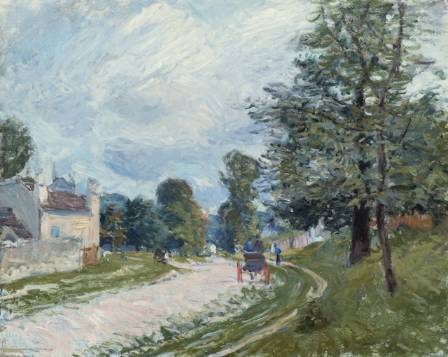
Sisley portrays a village partially submerged by floodwaters. Muted blues, greens, and grays capture the reflective surface of the water, while scattered buildings and boats suggest the villagers’ resilience. His delicate brushwork conveys texture and atmosphere, evoking the emotional and visual impact of nature’s power. This piece exemplifies Sisley’s mastery of capturing fleeting weather conditions and moods.
Berthe Morisot – "The Garden at Bougival" (1884)
Medium: Oil on canvas
Location: Private collection
Morisot’s painting offers a private view of a sunlit garden, where dappled light filters through the foliage. Her lively brushwork brings the scene to life, while her careful attention to light enhances realism. As one of the few leading female Impressionists, Morisot often emphasized personal and emotional responses to nature, and this work exemplifies her innovative, sensitive approach to capturing fleeting moments in the natural world.
Edgar Degas – "Landscape with Smokestacks" (1890)
Medium: Oil on canvas
Location: Art Institute of Chicago
Degas combines pastoral and industrial imagery in this landscape, juxtaposing fields with looming smokestacks. Muted tones and geometric forms highlight the tension between nature and industrialization. While best known for figurative work, Degas demonstrates versatility here, exploring contemporary themes through a nuanced depiction of the environment.
Gustave Caillebotte – "The Seine and the Railway Bridge at Argenteuil" (1885)
Medium: Oil on canvas
Location: Private collection
Caillebotte’s painting blends precise realism with Impressionist technique. The Seine is tranquil yet dynamic, with reflections capturing movement and light. The juxtaposition of natural beauty with modern engineering, such as the railway bridge, symbolizes progress. His subtle use of light and shadow enhances depth, showing an innovative merger of realism and Impressionist ideals.
Armand Guillaumin – "Confluent de la Seine et de la Marne à Ivry" (1889)
Medium: Oil on canvas
Location: Private collection
Guillaumin portrays the meeting of two rivers near Paris, using bright, expressive colors. The scene combines rural serenity with water and sky reflections, captured with lively, harmonious brushwork. His emphasis on light and color demonstrates the Impressionist focus on nature’s transient beauty.
Paul Cézanne – "Mont Sainte-Victoire" (1887)
Medium: Oil on canvas
Location: Metropolitan Museum of Art, New York
Cézanne’s depiction of Mont Sainte-Victoire emphasizes structure and form over fleeting light effects. Geometric shapes and earthy tones convey the mountain’s enduring presence. This analytical approach bridges Impressionism and Post-Impressionism, laying the foundation for modern art. The painting’s careful composition and emotional depth make it a pivotal work in landscape history.
Claude Monet – "Water Lilies and Japanese Bridge" (1899)
Medium: Oil on canvas
Location: Princeton University Art Museum
Monet captures his Giverny garden with water, reflections, and lush vegetation. The Japanese bridge forms a central focal point amid soft colors and diffused light. The abstract quality of the composition highlights patterns and reflections, foreshadowing modernist movements. This masterpiece exemplifies Monet’s talent for rendering the essence of nature and the lasting influence of Impressionism.
Conclusion
These ten Impressionist landscapes reveal the movement’s diversity and innovation. From Monet’s ethereal light effects to Cézanne’s geometric analysis, each painting presents a unique perspective on nature. Together, they demonstrate the enduring legacy and transformative impact of Impressionism in the world of art.
More from the edition
Column · en
The Most Beautiful and Magical Desert on Earth — Brazil’s Desert
The world is filled with extraordinary places and rare natural phenomena that seem almost impossible to imagine. One of these remarkable landscapes can be found in Brazil, where vast white sand dunes surround crystal-clear lagoons in shades of turquoise and blue-green. The water is so transparent that the bottom can often be seen, while fish and shrimp move beneath the surface. When the sun begins to set, the entire landscape takes on an even more spectacular appearance. The result looks almost like a paradise created on Earth.
Column · en
Celebrating Biodiversity: Asian Crested Ibis
The Asian crested ibis (Nipponia nippon) is a bird with a special place in Japanese culture and history. It was mentioned in Japan’s second-oldest historical record, Nihon Shoki (The Chronicles of Japan), completed in 720. Known as the toki in Japanese, this elegant bird once inhabited a wide region, including all of Japan, southeastern Siberia, central and eastern China, and the Korean Peninsula.
Column · en
5 Key Considerations Before Creating a Cozy Corner in Your Home
In today's fast-paced world, having a peaceful space to retreat to within your home has become more essential than ever. No matter the size of your living space—whether large or small—creating a cozy corner can provide you with a sanctuary to unwind, relax, and rejuvenate. These corners, carefully designed for comfort and warmth, are a growing trend in home décor and can significantly enhance the atmosphere of your home. Below are five key factors to keep in mind before setting up your own intimate nook, from furniture arrangement to lighting and personal touches.
Column · en
6 of the World’s Most Impressive Piers
Across coastlines worldwide, piers stand as a bridge between land and sea. Some are beloved for their seaside entertainment, others are marvels of history, while a few are celebrated simply for their sheer size. Built from timber, concrete, or steel, these structures have become icons of both engineering and culture. Here are six of the most extraordinary piers on the planet.
Column · en
The Illusion of Space: Clever Hacks to Create Your Dream Walk-In Wardrobe in Any Home
Dreaming of a sprawling walk-in wardrobe but constrained by a compact city apartment? You’re not alone. While a dedicated dressing room is the ultimate luxury, the reality for many is a cramped bedroom with limited storage. The good news is that with some clever spatial reconfiguration and smart design tricks, you can carve out a high-functioning, diva-worthy closet in the most unlikely of places. Here’s how to transform overlooked corners into your personal fashion sanctuary.
Column · en
How to Grow and Care for an Orchid So It Blooms for Years
Orchids (family Orchidaceae) are elegant houseplants that can also serve as decorative elements when placed in attractive containers. Although they are often thought of as hard to maintain, orchids can actually thrive for as long as 15 years when their needs are properly met. With roughly 25,000 species available, one of the most beginner-friendly options is the moth orchid (Phalaenopsis). Regardless of the variety you choose, understanding a few essential care principles will help your orchid stay healthy and bloom beautifully indoors.