Sunday column
What Is a Satellite?
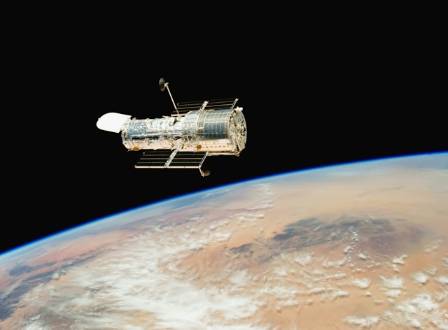
When you hear the word “satellite,” you may immediately picture a large metal spacecraft traveling around Earth high above the planet.
Cael Arden
Desk editor
Editor’s note
The full column continues in quiet type below.
Section
Sunday Broadsheet
When you hear the word “satellite,” you may immediately picture a large metal spacecraft traveling around Earth high above the planet.
However, Earth and the Moon can also be considered satellites. A satellite is any object that travels around a planet, star, or moon along an orbit. An orbit is a regular and repeating route that one object in space follows around another. Earth is therefore a satellite because it travels around the Sun, while the Moon is a satellite because it circles Earth.
In everyday conversation, though, the term “satellite” most often refers to a human-made machine launched into space to travel around Earth or another object in space.
Earth and the Moon are examples of natural satellites. At the same time, thousands of artificial satellites created by humans are orbiting Earth. Some are equipped with cameras that photograph our planet, providing information that meteorologists use to forecast weather and monitor hurricanes. Others observe planets, the Sun, black holes, dark matter, and distant galaxies. The information and images collected by these spacecraft help scientists learn more about our solar system and the wider universe.
There are even satellite galaxies. In astronomy, this term describes smaller galaxies that orbit larger galaxies.
Satellites for Communication and Navigation
Not every satellite is designed primarily for scientific observation. Many are used to support communication services, including television broadcasts and telephone calls around the world.
Satellites also play an important role in navigation. When you use a smartphone map to locate your home or search for a nearby place, satellites are helping determine your position through GPS.
The Global Positioning System, commonly known as GPS, consists of more than 30 satellites. By receiving signals from these satellites, GPS-enabled devices can determine a person’s precise location.
Why Are Satellites Important?
One major advantage of satellites is their ability to observe enormous areas of Earth at the same time. Because they can view such large regions, satellites can gather much more information in a shorter period than many instruments located on the ground.
Satellites are also able to observe outer space more effectively than telescopes positioned on Earth's surface in many situations. This is because spacecraft can operate above clouds, dust, and atmospheric molecules that may interfere with observations made from the ground.
By traveling above the atmosphere, satellites can provide clearer views of both our planet and distant objects in space.
What Parts Make Up an Artificial Satellite?
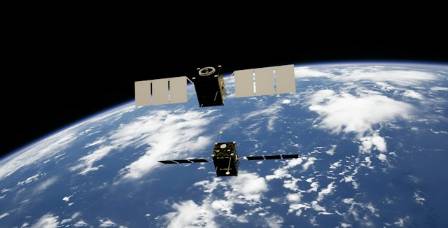
Artificial satellites can differ greatly in their shape, size, and purpose. Despite these differences, most satellites share at least two basic components: an antenna and a source of electrical power.
The antenna allows the spacecraft to transmit and receive information, often communicating with stations or systems on Earth. Like electronic devices on the ground, satellites also require energy to operate.
Satellites can obtain power in several ways, including through batteries and solar panels. Solar panels are particularly useful because they convert sunlight into electricity, providing a renewable source of power while the spacecraft is exposed to the Sun.
Many NASA satellites also carry cameras and scientific instruments. Some of these instruments are directed toward Earth to collect information about the planet’s land, atmosphere, and water. Others point outward into space to gather observations about the solar system and the universe.
How Do Satellites Orbit Earth?
Most artificial satellites reach space aboard rockets. Once in orbit, a satellite remains around Earth because its forward motion is balanced by Earth's gravitational pull.
Without the right balance between speed and gravity, a spacecraft would either continue moving away from Earth along a straight path or lose enough motion to fall back toward the planet.
Satellites can operate at many different altitudes and travel at different speeds along a variety of orbital paths. Two of the most common types are geostationary orbits and polar orbits.
A geostationary satellite travels from west to east above the equator. It moves in the same direction as Earth's rotation and completes its movement at the same rate as the planet turns.
Because of this synchronization, a geostationary satellite appears to remain fixed over one location when viewed from Earth.
Polar-orbiting satellites follow paths that carry them generally from north to south, passing close to the planet’s poles. As Earth rotates underneath them, these spacecraft can gradually observe the entire globe, scanning one section of the planet at a time.
Why Don't Satellites Crash Into Each Other?
Satellites can actually collide. In February 2009, an American communications satellite and a Russian communications satellite collided in space. It is considered the first known accidental collision between two artificial satellites.
Fortunately, such events are uncommon. NASA and other organizations around the world continuously monitor objects and satellites in space. When a spacecraft is launched, it is normally placed into an orbit planned to reduce the likelihood of encountering other satellites.
However, orbital conditions can change over time. As more and more spacecraft are sent into orbit, the number of objects in space increases, which also increases the possibility of collisions.
What Is the History of NASA Satellites?
NASA began launching satellites into space in the late 1950s. Explorer 1, launched in 1958, was the first U.S. artificial satellite and the first American satellite to carry scientific instruments.
One of its primary instruments was designed to detect high-energy particles in space known as cosmic rays. The mission helped scientists begin gathering scientific information directly from beyond Earth's atmosphere.
NASA's Explorer 6 produced the first satellite image of Earth in 1959. The following year, TIROS-1 produced the first television image of Earth from space.
The earliest images were extremely limited compared with the detailed photographs produced by modern spacecraft. Even so, they demonstrated the enormous possibilities of satellite technology and showed how spacecraft could change the way humans observe Earth and the surrounding universe.
How Does NASA Use Satellites Today?
Today, NASA satellites are used to study Earth, other planets in our solar system, and objects far beyond it.
Satellites observing Earth collect information about clouds, oceans, land surfaces, and ice. They also measure gases in the atmosphere, including carbon dioxide.
NASA's Orbiting Carbon Observatory 2, known as OCO-2, was launched in 2014 to measure carbon dioxide concentrations around Earth and improve scientists’ understanding of the planet’s carbon cycle. OCO-2 also helps researchers investigate how observations made from space can be used to understand future changes in carbon dioxide and their potential effects on Earth's climate.
Satellites can measure how much energy Earth retains within its atmosphere as well as how much energy the planet releases back into space. They can also monitor wildfires, volcanoes, and the smoke produced by these events.
The information collected from space has many practical uses. It helps scientists improve weather and climate predictions, assists public health officials in monitoring disease and famine, provides farmers with information that can help them determine what crops to grow, and supports emergency responders during natural disasters.
Even a daily weather forecast depends heavily on observations collected by satellites.
Satellites Exploring Space
Satellites and spacecraft that observe beyond Earth perform many different scientific tasks. Some monitor potentially dangerous radiation and other forms of energy coming from the Sun.
Others study asteroids and comets, investigate how stars develop and change, or examine the processes involved in the formation of planets.
Some spacecraft travel close to or enter orbit around other planets. These missions can search for signs of water on Mars or obtain detailed images of Saturn's rings.
Through these missions, satellites allow scientists to explore regions of space that would otherwise be impossible to study directly and continue expanding our understanding of Earth, the solar system, and the universe.
More from the edition
Column · en
Raccoons — Facts and Fancies
The raccoon (Procyon lotor) is a member of the carnivore order, a group of mammals that mainly consume meat but may also eat plant materials such as berries, fruits, vegetables, eggs, acorns, beech nuts, hickory nuts, grains, grasses, and tree bark when other food sources are limited. Like other carnivores, raccoons have five toes on each foot and large canine teeth. However, raccoons are omnivorous animals, and the balance between plant and animal foods in their diet changes depending on the season and available resources.
Column · en
Choose the Best Down Jacket
When temperatures drop and staying warm becomes a priority, a dependable down jacket is one of the most practical and versatile pieces of outdoor clothing you can own. Whether you are preparing for a winter hiking trip, exploring snowy mountains, or simply looking for a comfortable everyday jacket during the colder months, a quality down jacket can provide excellent warmth and protection.
Column · en
Sculpted by the Sea: The Dynamic Geology of Rocky Coastlines
The relentless pounding of surf and breaking waves has shaped rocky coasts into some of the most dramatic landscapes on Earth. Characterized by high-energy erosion, these coasts are typically found along active tectonic margins with narrow continental shelves. Composed of sedimentary, igneous, or metamorphic rock, they bear witness to complex geological processes, including faulting, folding, and volcanic activity. The specific profile of a rocky coast—whether steep cliffs or gentle slopes—is dictated by the interplay of bedrock resistance, climate, and wave energy. For instance, the resistant lava flows of Kalaupapa National Historical Park (Hawaii) create towering sea cliffs, while the more erodible limestones of Dry Tortugas National Park (Florida) form gentler slopes. Glacial activity further sculpts these regions, carving deep fjords and depositing talus slopes, while carbonate coasts can lithify into eolianite dunes that later erode into steep bluffs.
Column · en
The Giant Panda: A Black-and-White Icon of Conservation
The giant panda (Ailuropoda melanoleuca) is one of the world’s most recognizable and beloved mammals, a member of the bear family distinguished by its striking black-and-white fur and gentle demeanor. Native exclusively to China’s mountainous regions, these iconic creatures have long captured global attention—not just for their adorable appearance, but also for their remarkable conservation journey, which has seen them rebound from the brink of extinction to a status of “Vulnerable” on the IUCN Red List. Beyond their cultural significance as China’s national treasure, giant pandas play a vital role in their forest ecosystems, serving as an umbrella species whose protection benefits countless other plants and animals sharing their habitat. From their specialized diet to their solitary lifestyle, every aspect of the giant panda reflects a unique adaptation to the challenging mountain environment they call home.
Column · en
Why the CN Tower Stands Out in Toronto
Towering over Toronto’s skyline at 553.3 metres (1,815 ft), the CN Tower became the world’s tallest free-standing structure from its opening in June 1976 until it was overtaken in 2007. Initially conceived as a broadcast mast, its designers soon expanded the vision—adding elevators, observation decks, a rotating restaurant, shops, and daring experiences. Today it draws more than 1.5–2 million visitors each year to witness its blend of architecture, views, and excitement.
Column · en
Best Single Chairs for Living Room
Over the last ten years, I’ve sourced and specified countless accent chairs for living rooms, and the designs that consistently stand out combine visual impact, ergonomic comfort, and long-lasting craftsmanship.