Sunday column
Seven Surprising Facts about Coral
When you picture the ocean, you may immediately think of vibrant coral reefs filled with remarkable colors, unusual shapes, and countless marine creatures. Although coral reefs are beautiful to look at, there is far more happening beneath the surface than their appearance suggests. Understanding what makes corals unique also helps us recognize why they are so important to protect, both for the health of our oceans and for the planet as a whole.
Ronel Whitlock
Desk editor
Editor’s note
The full column continues in quiet type below.
Section
Sunday Broadsheet
When you picture the ocean, you may immediately think of vibrant coral reefs filled with remarkable colors, unusual shapes, and countless marine creatures. Although coral reefs are beautiful to look at, there is far more happening beneath the surface than their appearance suggests. Understanding what makes corals unique also helps us recognize why they are so important to protect, both for the health of our oceans and for the planet as a whole.
1: Corals Are Animals
Because of their branching forms, corals are sometimes thought to be plants. Others may mistake them for rocks because certain corals build hard calcium carbonate skeletons around their soft bodies. In reality, corals are animals.
“Coral is an animal, with plant-like cells living inside of it,” explained Shedd Research Biologist Dr. Ross Cunning.
Individual coral polyps are tiny animals, each equipped with a mouth and a stomach. They reproduce and multiply to create larger colonies, which eventually become the foundation of coral reefs. Since corals grow very slowly, a colony may begin with just a single polyp and continue growing and dividing over hundreds or even thousands of years. Some colonies can eventually reach the size of a car or even a house.
Reef-building corals are related to other animals such as jellyfish and sea anemones. Together, these creatures belong to a group known as “Cnidarians.” Coral reefs rank among the largest living structures on Earth, with some extensive reef systems even visible from space.
2: Corals Can Be Fluorescent
Some coral species have the natural ability to produce fluorescent pigments, creating an impressive range of colors. According to Cunning, these fluorescent compounds may serve as a form of protection by helping shield corals from ultraviolet radiation and excessive light.
Corals are also considered indicator species because they are highly responsive to changes in their surrounding environment. When conditions remain favorable, individual coral colonies have been observed surviving for hundreds or thousands of years. Researchers believe that under exceptionally stable conditions, some corals may potentially survive indefinitely.
Although coral colonies can resemble plants because of their repeated branching forms, they are actually made up of many small animals living together in a symbiotic relationship.
3: Corals Eat Plankton and Small Fish
Every coral polyp has specialized stinging cells located on its tentacles. These cells work much like tiny harpoons, allowing the coral to capture drifting organisms and plants collectively known as plankton.
Like their relatives, the jellyfish, corals use these stinging cells to seize, immobilize, and consume plankton as well as small fish that come within reach.
Corals also receive energy through an important partnership with microscopic algae. These algae live inside coral cells and have a mutually beneficial relationship with their hosts. Using sunlight, the algae create food that provides the coral with an additional source of energy.
4: There Are Hundreds of Coral Species in Many Colors, Shapes, and Sizes
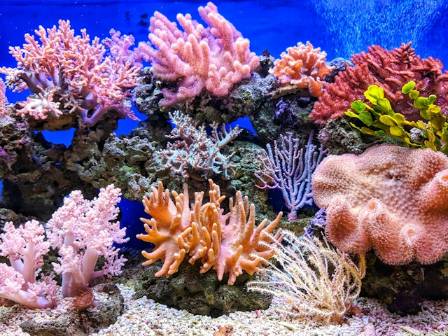
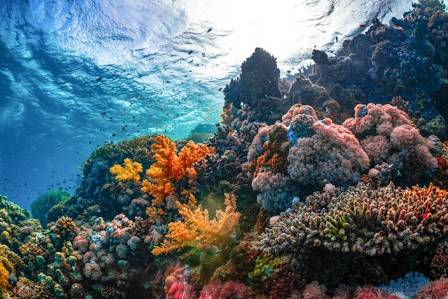
Corals display extraordinary variety in their appearance, with different species developing a huge range of forms, dimensions, and colors.
Mound and boulder corals form large, rounded structures that resemble the enormous mounds suggested by their names. Brain corals have intricate grooves and winding patterns that resemble the surface of a human brain.
Branching corals may grow vertically and outward in forms similar to trees, while others spread horizontally and develop broad, flat surfaces resembling tables. Sea fans, which are a type of soft coral that does not produce a rigid external skeleton, can form enormous fan-shaped structures that gently sway with ocean currents.
Sea pens and sea whips can also resemble underwater trees, sometimes creating what looks remarkably like a forest beneath the surface. Pillar corals grow upward in tall, column-shaped structures, and groups of them can create an appearance similar to a city skyline.
5: Corals Can Move
Adult corals remain attached to the ocean floor, but they are capable of movement during their early larval stage.
When corals reproduce, they release eggs and sperm into the surrounding seawater. Once the reproductive cells meet and fertilization takes place, they develop into tiny coral larvae that are able to swim.
These young larvae can travel with ocean currents. When they encounter a suitable location where they can establish themselves, they descend toward the seafloor, attach to the surface, and begin developing into a new coral colony.
6: Corals Support 25 Percent of Ocean Life
Corals are often described as foundational species, architectural species, or ecosystem engineers because they create the physical structures that provide living space for countless other organisms.
Cunning compares a coral reef to a forest beneath the sea, describing it as a three-dimensional structure that rises from the ocean floor. Just as a forest depends on its trees, a reef community depends on the framework created by coral. The numerous spaces, crevices, and sheltered areas within a reef provide habitat for an enormous and highly diverse collection of marine organisms.
Coral reefs do much more than provide homes for marine animals. They also supply food and livelihoods for hundreds of millions of people. Coral reefs contribute to the formation of white sandy beaches and help protect coastlines from as much as 90 percent of potentially destructive waves and flooding.
The combined value of the services and benefits provided by coral reefs to people is estimated at approximately $10 trillion every year.
7: Climate Change Is the Biggest Threat to Corals
Climate change is placing enormous pressure on already vulnerable coral populations, particularly as rising ocean temperatures create increasingly stressful conditions.
Cunning explains that coral bleaching occurs when corals experience excessive heat. As ocean temperatures rise, corals respond to the stress by expelling the symbiotic algae that live within their tissues. Without these algae, the corals lose their color and become pale or almost completely white. More importantly, they lose a major source of energy and become highly vulnerable to starvation and disease.
Bleached corals are essentially deprived of food, and they may die if water temperatures remain elevated rather than returning to a safer range.
As global temperatures increase, coral bleaching events are becoming more frequent and more severe. Cunning warns that without meaningful efforts to reduce greenhouse gas emissions, climate change could eliminate much of the world’s coral reef habitat within the coming decades.
Individuals can also contribute to efforts to reduce the effects of climate change. This includes supporting immediate and substantial climate action from state and national representatives, increasing public awareness, and helping communicate why climate advocacy and environmental protection are important.
Taking meaningful action gives coral reefs and many other threatened ecosystems a greater opportunity to survive and recover.
More from the edition
Column · en
Care Guide for the ZZ Plant
The ZZ plant (Zamioculcas zamiifolia), also known as the Zanzibar Gem, is a popular low-maintenance houseplant recognized for its glossy, oval-shaped leaves that grow along long, thick stems.
Column · en
What Is a Satellite?
When you hear the word “satellite,” you may immediately picture a large metal spacecraft traveling around Earth high above the planet.
Column · en
Raccoons — Facts and Fancies
The raccoon (Procyon lotor) is a member of the carnivore order, a group of mammals that mainly consume meat but may also eat plant materials such as berries, fruits, vegetables, eggs, acorns, beech nuts, hickory nuts, grains, grasses, and tree bark when other food sources are limited. Like other carnivores, raccoons have five toes on each foot and large canine teeth. However, raccoons are omnivorous animals, and the balance between plant and animal foods in their diet changes depending on the season and available resources.
Column · en
How to Grow and Care for an Orchid So It Blooms for Years
Orchids (family Orchidaceae) are elegant houseplants that can also serve as decorative elements when placed in attractive containers. Although they are often thought of as hard to maintain, orchids can actually thrive for as long as 15 years when their needs are properly met. With roughly 25,000 species available, one of the most beginner-friendly options is the moth orchid (Phalaenopsis). Regardless of the variety you choose, understanding a few essential care principles will help your orchid stay healthy and bloom beautifully indoors.
Column · en
The Definitive Manual for Selecting the Ideal Men’s Shirt
The shirt serves as the fundamental building block of a man's wardrobe. Consequently, identifying the precise dimensions and silhouette is essential to making a successful purchase. Given the vast array of aesthetic variations, selecting the perfect piece requires an understanding of how style choices influence the final look. This guide provides a strategic overview to help you navigate your next acquisition.
Column · en
Iconic Fried Delicacies from Every Corner of the Globe
Whether you are craving something sugary or a savory treat, fried snacks are a universal favorite. The appealing contrast between a crunchy, golden exterior and a tender, warm interior creates a sensory experience that many find irresistible. While the world offers an endless variety of fried foods, certain classics have achieved legendary status across international borders.