Sunday column
Colourful Macaroons
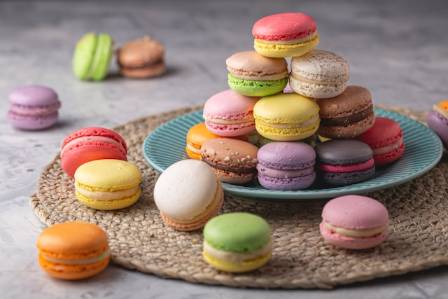
Enter the playful universe of bright, delicate macarons—sometimes also referred to as macaroons—where every light, airy bite delivers a harmony of taste and a splash of vivid color. These famous French pastries have become a worldwide favorite among dessert lovers, admired for their crisp outer shells and smooth, flavorful fillings.
Daniel Foster
Desk editor
Editor’s note
The full column continues in quiet type below.
Section
Sunday Broadsheet
Enter the playful universe of bright, delicate macarons—sometimes also referred to as macaroons—where every light, airy bite delivers a harmony of taste and a splash of vivid color. These famous French pastries have become a worldwide favorite among dessert lovers, admired for their crisp outer shells and smooth, flavorful fillings.
Let’s explore the charming world of macarons, from their endless flavor combinations to their eye-catching appearance.
Flavors to Enjoy
Macarons are celebrated for their remarkable adaptability in flavor, offering something for nearly every preference. From traditional choices to creative modern blends, the variety is nearly limitless.
Enjoy the refined simplicity of vanilla, where gentle sweetness pairs beautifully with the nutty almond base. For fruit-inspired options, raspberry, lemon, and passionfruit bring bright, tangy freshness. Chocolate varieties deliver deep, rich cocoa notes, while coffee-flavored versions offer a bold espresso aroma.
For richer indulgence, salted caramel, pistachio, and hazelnut create a pleasing contrast between sweet and savory, turning macarons into elegant gourmet bites. Seasonal variations—such as spiced pumpkin in autumn or peppermint mocha during winter festivities—add a festive twist to dessert tables.
A Spectrum of Colors
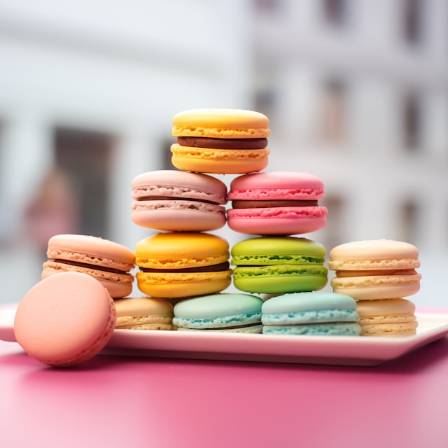
Equally captivating as their taste is their colorful appearance, which turns macarons into miniature edible artworks. Their shades range from soft, delicate tones to striking, vibrant hues, reflecting endless creative possibilities.
Traditional macarons are often seen in gentle pinks, pale yellows, and light greens reminiscent of spring blossoms. However, modern pastry makers now experiment with bold blues, deep violets, and vivid reds, producing visually dramatic assortments. Whether arranged in a single-color theme or a full rainbow display, macarons bring charm and joy to any setting.
In this delightful pastry world, taste and color come together to create a multisensory experience that pleases both the eyes and the palate. No matter the occasion, these treats always leave a memorable impression with their elegance and sweetness.
Ingredients
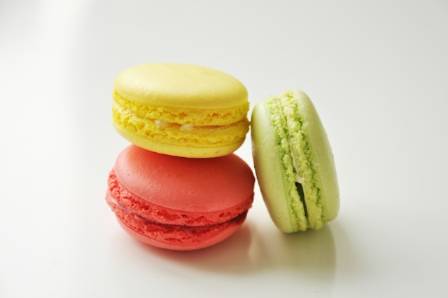
110 g almond meal
200 g icing sugar
3 egg whites
50 g caster sugar
food coloring (optional)
flavor extracts or powders (optional)
filling of choice (ganache, buttercream, jam, etc.)
Instructions
Place almond meal and icing sugar into a food processor and blend briefly until fine and evenly mixed. Move the mixture into a large bowl.
In a separate bowl, whisk egg whites using an electric mixer at medium speed until they become foamy. Slowly add caster sugar while continuing to whisk. Increase speed to high and beat until stiff, glossy peaks form.
Carefully fold the meringue into the almond mixture using a spatula until just combined. Avoid overmixing. At this stage, add any coloring or flavoring if desired and gently incorporate.
Transfer the batter into a piping bag fitted with a round nozzle. Pipe small rounds (around 2.5 cm wide) onto baking trays lined with parchment paper, leaving space between each.
Allow the piped shells to rest at room temperature for 30–45 minutes until a thin skin forms. Meanwhile, preheat the oven to 150°C (300°F).
Bake for 12–15 minutes until the shells are firm and set. Remove and let them cool completely on the tray.
Once cooled, match similar-sized shells. Add filling to one shell and gently sandwich with another.
Serve immediately, or store in an airtight container in the refrigerator for up to 3 days to allow flavors to develop and texture to soften.
More from the edition
Column · en
A Good Bowl of Borscht Can Change Your Life
The best bowl of borscht I ever tasted came from a punk house in the summer before I turned eighteen. At that point, I had already been on my own for nearly two years, drifting between whoever would take me in after my mother left town. I survived mostly on whatever vegan food I could scavenge or afford, eating a very simple, carb-heavy diet that kept me going but not much more.
Column · en
Sparkling Flavored Water with Fruit
Make your afternoon sparkle with a fruity, fizzy drink! This flavored sparkling water with tropical fruit is refreshing, hydrating, and naturally sweet. All you need is a can of bubbly water and a handful of frozen fruit—easy, cheerful, and perfect for sipping on a sunny day.
Column · en
Fiddle Leaf Fig Houseplant
The name “Fiddle Leaf Fig” is sometimes used for two different plants: Ficus lyrata and Philodendron bipennifolium. It is common for one popular name to describe more than one species, and this is one such example. The care information below focuses on Ficus lyrata, the plant most often sold in garden centers and stores as a Fiddle Leaf Fig houseplant.
Column · en
The dead leaf butterfly: Master of camouflage
The dead leaf butterfly (Kallima inachus) is a remarkable example of natural camouflage. When its wings are folded, their appearance closely resembles that of a dried leaf, complete with dark vein-like patterns that help the butterfly disappear among fallen foliage.
Column · en
What are Examples of Geometric Shapes in Real Life?
Geometric shapes are everywhere. No matter where you look, almost everything is made up of both two-dimensional (2D) and three-dimensional (3D) geometric shapes. Keep reading for real-life geometric shape examples that make up the world around us.
Column · en
How to Revive a Dehydrated Tree: A Guide to Rehydrating Underwatered Trees
Trees, like all living plants, rely on a consistent supply of water to grow, maintain health, and perform photosynthesis. When a tree goes without moisture for too long, it becomes parched and may exhibit signs of serious stress. Helping such a tree recover involves more than just splashing water at its base—it requires a targeted approa